Showing posts sorted by relevance for query graphite. Sort by date Show all posts

China Graphite Spherical Graphite Output Falls as Natural Anode Demand Weakens

No comments
China Graphite Spherical Graphite Output Falls as Natural Anode Demand Weakens
China Graphite Group

China Graphite spherical graphite output fell in 2025 as weak demand from the natural graphite anode material sector and existing inventories pressured production. The Hong Kong-listed natural graphite producer produced 2,300t of spherical graphite during the year, down 28% from 2024.

The decline reflects a broader shift in China’s anode materials market. Battery producers are still expanding overall anode consumption, but natural graphite is losing share to artificial graphite because of performance and price competition.

China Graphite spherical graphite output weakness shows that battery material growth does not benefit all feedstock routes equally. Natural graphite remains important, but artificial anode materials are gaining ground because they offer stronger cycling life and rate performance for many lithium-ion battery applications.

Spherical graphite sales also fell in 2025, although less sharply than production. China Graphite sold 5,815t of spherical graphite, down 6.9% from a year earlier, suggesting the company partly relied on existing inventory to meet demand.

Artificial Graphite Competition Pressures Natural Anode Feedstock

China’s anode material shipments rose strongly in 2025, reaching 2.9mn t, up 39% from a year earlier. However, natural graphite anode materials moved in the opposite direction.

Natural graphite anode shipments fell to 210,000t in 2025, down 19% from the previous year. Their share of China’s total anode material shipments dropped to 7.2%, showing that natural graphite is becoming a smaller part of the domestic anode mix.

This matters directly for spherical graphite producers. Spherical graphite is a key processed feedstock for natural graphite anode materials. When natural anode production slows, spherical graphite demand weakens quickly.

China Graphite attributed the decline to price competition and lower output of natural graphite anode materials. The company also pointed to the shorter cycling life and weaker rate performance of natural graphite compared with artificial anode materials.

Artificial graphite has become dominant in China’s battery supply chain because many battery makers prioritise consistency, fast charging performance and long cycle life. These factors are especially important for electric vehicles and energy storage systems.

The result is a margin squeeze for natural graphite processors. Even when total battery demand grows, spherical graphite producers must compete against artificial graphite suppliers that are more closely aligned with mainstream cell performance requirements.

Flake Graphite Output Rises Despite Spherical Graphite Weakness

China Graphite’s upstream natural graphite flake business performed better than its spherical graphite segment. The company produced 57,600t of natural graphite flake in 2025, up 10.8% from a year earlier.

The increase was supported by equipment upgrades, showing that China Graphite improved mining or processing efficiency even as downstream spherical graphite demand weakened. Flake graphite sales also edged higher by 1.3% to 46,020t.

This creates a mixed operating picture. Upstream flake output increased, but downstream spherical graphite production fell sharply. The gap suggests that the company may need to manage feedstock allocation carefully if natural anode demand remains weak.

Natural graphite still has strategic value. It can support lower-cost anode production and remains important for battery supply-chain diversification. However, its competitiveness depends on purification, coating, consistency, performance and customer qualification.

For China Graphite, the next challenge is not only producing more flake graphite. It must defend its position in higher-value downstream graphite products as the anode market shifts toward artificial materials and more demanding battery specifications.

The company’s results also highlight a wider issue for natural graphite markets. Supply growth alone is not enough. Producers need downstream demand from qualified anode makers, battery customers and applications where natural graphite retains a cost or performance advantage.

The Metalnomist Commentary

China Graphite’s results show that battery demand growth is becoming more selective across the graphite value chain. Natural graphite suppliers must improve processing quality and downstream integration if they want to compete against artificial graphite in high-performance batteries.

ExxonMobil battery anode graphite deal signals new push into EV batteries

No comments
ExxonMobil battery anode graphite deal signals new push into EV batteries
ExxonMobil

The ExxonMobil battery anode graphite deal marks a strategic shift toward advanced battery materials. The company will acquire the US assets and technology of Superior Graphite to gain a foothold in battery anode graphite. As a result, the ExxonMobil battery anode graphite deal aims to convert refining-derived carbon streams into higher value synthetic graphite products.

Synthetic graphite strategy builds on ExxonMobil refining strengths

ExxonMobil battery anode graphite deal execution leans heavily on the group’s refining skills and feedstock access. Synthetic graphite production can use carbon-rich streams from existing oil refineries, rather than rely on traditional mined graphite. Therefore, the company can integrate battery anode graphite manufacturing into current industrial sites with established utilities and logistics.

Producing synthetic graphite is also less labour intensive than conventional mining operations. This shift supports more predictable quality and supply for high performance battery anodes, especially for EV and energy storage systems. Meanwhile, Superior Graphite’s technology portfolio should help accelerate product qualification with cell manufacturers and automotive OEMs.

ExxonMobil expects demand for higher performance batteries and advanced graphite materials to grow significantly. As a result, the company views synthetic graphite as a natural extension of its downstream product chain. However, it still needs to prove that oil-to-anode economics can compete with incumbent graphite suppliers in Asia.

Energy transition focus must still compete for capital

The ExxonMobil battery anode graphite deal fits into a broader energy transition strategy built around familiar skill sets. The company is already investing in carbon capture, hydrogen and low-emission fuels that leverage existing process and project expertise. Therefore, battery anode graphite offers another pathway where ExxonMobil can combine scale, engineering and feedstock advantages.

Yet internal capital allocation remains disciplined and competitive. Management has repeatedly stressed that new technologies, including carbon capture and hydrogen, must compete with core oil and gas projects for investment. Likewise, the ExxonMobil battery anode graphite deal will need to deliver attractive returns against upstream and petrochemical options. This requirement could limit speed of expansion if market conditions or pricing weaken.

In addition, graphite remains a politically sensitive material within global battery supply chains. Western buyers seek alternatives to Chinese-dominated supply, but must balance cost, performance and ESG criteria. If ExxonMobil can demonstrate low emission synthetic graphite at scale, it may win premium contracts from OEMs under pressure to de-risk their anode sourcing.

The Metalnomist Commentary

ExxonMobil’s move into battery anode graphite shows how oil majors now seek value in critical mineral adjacencies rather than pure mining. Success will depend on whether integrated refinery-based synthetic graphite can match Asian competitors on cost and performance. Market participants should watch for offtake deals with cell makers, which will reveal how quickly this new graphite platform gains traction.

Syrah Graphite Offtake Supports Non-China Anode Supply Chain Strategy

No comments
Syrah Graphite Offtake Supports Non-China Anode Supply Chain Strategy
Syrah resources

Syrah graphite offtake plans with NextSource Materials could strengthen non-China graphite supply routes for battery anode production. The Australian producer may sell 34,000-68,000t of natural graphite fines over seven years, subject to commercial production at NextSource’s planned Abu Dhabi anode material plant.

The Syrah graphite offtake agreement depends on several conditions. NextSource has not yet made a final investment decision on the Abu Dhabi project, and both NextSource and its customers must approve the use of Syrah’s graphite fines. This makes the deal strategically important, but still dependent on qualification, financing, and project execution.

Syrah will supply the material from its Balama graphite mine in Mozambique. The mine produced 34,400t of natural graphite in October-December 2025, up from 25,700t in the previous quarter and no production a year earlier.

Balama Graphite Gains Value as Buyers Seek Supply Diversity

Balama graphite is becoming more important as battery supply chains seek alternatives to China-linked material flows. Syrah said the NextSource agreement prices Balama graphite at a premium to market indices, suggesting that qualified non-China supply is gaining strategic value.

Syrah’s average realised graphite price, including fines and coarse flakes, rose by 11pc year on year to $506/t fob Nacala in October-December 2025. Higher realised pricing supports the company’s effort to rebuild sales momentum after production interruptions and weak market conditions.

The deal also fits Syrah’s long-standing plan to increase graphite sales outside China. The company signed a six-year offtake agreement with South Korean producer Posco in 2024 and agreed to supply graphite to US producers Graphex Technologies and Westwater in 2023.

Graphite Trade Restrictions Increase Supply Chain Urgency

Graphite is moving deeper into the critical minerals policy debate because it is essential for lithium-ion battery anodes. China remains dominant in graphite processing, so automakers, battery makers, and governments are trying to develop alternative sources of feedstock and anode material production.

NextSource’s planned Abu Dhabi anode material plant could add a new processing node outside China if it reaches commercial production. Syrah’s graphite fines would provide feedstock for that strategy, while Mozambique would remain an important upstream source.

The timing matters because graphite trade restrictions are increasing. China recently banned sales of dual-use products, including graphite, to some Japanese producers. This reinforces the need for diversified supply chains that can connect African mine output, Middle Eastern processing, and battery customers in allied markets.

The Metalnomist Commentary

The Syrah-NextSource agreement shows that graphite supply security now depends on qualification pathways, not only mine output. Non-China anode supply chains will need reliable feedstock, bankable processing projects, and customers willing to pay for geopolitical resilience.

Japan-Australia Graphite Anode Supply Chain Targets Battery Security

No comments
Japan-Australia Graphite Anode Supply Chain Targets Battery Security
Graphite

The Japan-Australia graphite anode supply chain is becoming a serious strategic project for battery materials security. Idemitsu, Marubeni, NSC, and Graphinex have agreed to develop a cross-border supply chain for natural graphite anode material. The plan links graphite mining in Queensland with refining and processing in Japan. As a result, the Japan-Australia graphite anode supply chain could reduce reliance on more concentrated supply routes.

This matters because graphite remains one of the most important battery raw materials. Demand continues to rise with electric vehicles and renewable energy storage. Japan has relied heavily on imports for graphite procurement. Therefore, the Japan-Australia graphite anode supply chain directly addresses a critical supply risk.

The industrial structure of the deal is also clear. Idemitsu and Graphinex will handle graphite extraction in Australia. Marubeni and NSC will focus on refining and processing in Japan. Consequently, the project is designed as a full upstream-to-midstream partnership rather than a simple trading agreement.

Natural Graphite Anode Material Is Becoming a Strategic Priority

Natural graphite anode material is now central to battery manufacturing competitiveness. Without secure graphite supply, downstream battery production becomes more vulnerable to trade shocks and export restrictions. That makes source diversification more important than ever. As a result, Japan is moving to secure a more stable anode material base.

China’s role helps explain the urgency. Japan wants alternative import sources as it reduces dependence on the world’s largest graphite producer and exporter. Export controls have made that concentration risk harder to ignore. Therefore, the new partnership reflects both industrial logic and geopolitical caution.

Idemitsu’s earlier investment in Graphinex also shows this strategy did not begin overnight. The companies have already been building ties around Australian graphite mining. This new agreement pushes that relationship into a more integrated supply chain phase. Meanwhile, it strengthens confidence that the project has real strategic intent.

Graphite Anode Plant in Japan Could Deepen Domestic Battery Capacity

The graphite anode plant in Japan is the most important downstream element of the plan. The companies are exploring a Japanese production site and aim to start operations in 2028. That would give Japan more domestic control over an essential battery input. Consequently, the graphite anode plant in Japan could become a meaningful industrial anchor.

The partnership also aligns with the wider Japan-Australia critical minerals agenda. Both countries have been working to deepen cooperation on energy security and supply chains. This project fits that framework well because graphite sits at the core of battery manufacturing. Therefore, the deal supports both national policy and commercial demand.

The broader market significance is clear. Battery supply chains are no longer judged only by cell production capacity. They are increasingly judged by who controls upstream and midstream materials. As a result, the Japan-Australia graphite anode supply chain could become a notable model for allied critical mineral cooperation.

The Metalnomist Commentary

This partnership matters because it targets one of the most overlooked battery bottlenecks: graphite anodes. Japan is not only seeking more raw material. It is trying to secure processing and manufacturing depth as well. If execution stays on track, this project could become an important example of how allied supply chains move beyond dependence and into real industrial coordination.

China Graphite Cuts Output in 2024 Amid Shifting Anode Material Demand

No comments
China Graphite

China Graphite sees output decline as downstream buyers move to synthetic alternatives, reshaping the anode materials landscape.

Drop in Spherical Graphite Output Reflects Market Shift

China Graphite significantly reduced its spherical graphite production in 2024 due to weakened demand and seasonal production halts. The company produced 3,200t of spherical graphite, a steep 63% drop from 8,700t in 2023, citing low winter temperatures and market changes. Meanwhile, concentrate output also fell to 5,200t, down by 8.8% from 57,000t last year.

Sales of spherical graphite halved to 3,089t, while concentrate sales increased to 45,432t, up 25% year-on-year. The shift reflects a broader industry trend, as more battery makers turn to synthetic graphite due to cost efficiencies and stable feedstock supply.

Synthetic Graphite Dominates Battery Market

The battery industry increasingly favors synthetic anode materials over natural graphite. According to EV Tank, synthetic anode materials accounted for 84.4% of China's total battery anode shipments in 2024. Shipments rose to 2.12mn t, up 24% from 2023, underscoring the rising dominance of synthetic options.

Meanwhile, China Graphite’s natural graphite products found greater demand from non-battery sectors like refractories, flame retardants, and graphene. This diversification may offer some relief, but the pressure from synthetic graphite remains a key challenge.

The Metalnomist Commentary

China Graphite’s 2024 results highlight a structural pivot in anode materials.
As synthetic graphite strengthens its market position, natural graphite producers must adapt or risk marginalization in battery supply chains.

Dongdao Anode Production Expansion Adds More Capacity to China’s Battery Materials Chain

No comments
Dongdao Anode Production Expansion Adds More Capacity to China’s Battery Materials Chain
Dongdao Anode Production

Dongdao anode production expansion in Guangdong province shows that China continues to build scale across graphite and next-generation battery materials. Guangdong Dongdao New Material has started construction of two anode processing lines and one silicon-carbon anode line in Zhanjiang.

The two new processing lines will each have 10,000 t/yr of capacity. One line will produce synthetic graphite anode materials, while the other will produce natural graphite anode materials. The silicon-carbon anode line will have 500 t/yr of capacity, giving Dongdao a foothold in higher-performance battery material development.

Dongdao anode production growth matters because anode materials remain a core part of the lithium-ion battery value chain. China already dominates graphite processing, and the company’s latest investment reinforces the country’s ability to expand both conventional and advanced anode supply.

Graphite Anode Capacity Continues to Scale in China

Dongdao already operates 100,000 t/yr of natural graphite anode capacity and 100,000 t/yr of synthetic anode capacity. The new Zhanjiang lines will add more processing flexibility across both major graphite anode routes.

The company is also building much larger synthetic anode projects elsewhere in China. These include 300,000 t/yr of capacity in Leizhou, Guangdong, and 150,000 t/yr in Yilong, Guizhou. This shows that synthetic graphite remains a major investment focus as battery producers seek consistent performance, controlled quality, and scalable supply.

Dongdao’s subsidiary, Zhanjiang Juxin New Energy, also plans to build a 20,000 t/yr spherical graphite facility in Zhanjiang. A commissioning date has not yet been set, but the project would add another processing step that supports natural graphite use in battery anodes.

Silicon-Carbon Line Signals Next-Generation Battery Focus

The planned 500 t/yr silicon-carbon anode line is smaller than the graphite lines, but it carries strategic importance. Silicon-carbon anodes can improve battery energy density and performance, although commercial scaling remains more technically demanding than conventional graphite.

Dongdao’s decision to build this line alongside graphite processing capacity suggests a dual strategy. The company is expanding mainstream anode capacity while preparing for future demand from higher-performance battery chemistries.

All three Zhanjiang lines are scheduled to start operations in December 2027. By then, battery supply chains may be more focused on cost reduction, fast charging, energy density, and material efficiency. Producers with both graphite scale and silicon-carbon development capacity could be better positioned for that transition.

The Metalnomist Commentary

Dongdao’s expansion shows that China is not slowing its grip on the anode materials chain. The strategic issue for global battery supply chains is no longer only graphite availability, but who controls processing scale, qualification, and next-generation material development.

Evion to Export Expandable Graphite to Europe and Double Production Capacity

No comments
Evion

Evion, an Australian graphite mining company, is set to export 400 tons of expandable graphite to Europe during the first quarter of 2025. The exports will come from its joint venture facility, Panthera Graphite Technologies, in Pune, India, which began production in November and December 2024. The company plans to double its production capacity by the end of the year to meet growing global demand.

Production Growth and Market Strategy

Evion's Panthera Graphite Technologies joint venture, in partnership with Metachem Manufacturing, has already produced high-value expandable graphite for immediate export. According to Evion’s January 16 presentation, the company remains on track to complete its first 400-ton shipment to Europe by March.

To secure steady production over the next six months, Evion has 500 tons of graphite concentrate on-site, purchased on favorable terms in November 2024. This stockpile ensures stable pricing and supply certainty for the company’s ongoing operations.

Pricing, Cost Efficiency, and Expansion Plans

Panthera has locked in first-quarter pricing between $3,000-$3,300 per ton FOB, with expectations of a 10% price increase for second- and third-quarter sales. Production costs range between $1,500-$1,750 per ton, and the company sees potential for short-term cost savings.

Evion is executing a three-stage expansion plan:
  • Stage 1: Current production of 2,000-2,500 tons per year
  • Stage 2: Expansion to 4,000-4,500 tons per year by end of 2025
  • Stage 3: Full-scale production of 10,000 tons per year by 2026-2027
If successful, Panthera will become one of the largest producers of expandable graphite outside of China, strengthening its position in key markets such as Europe, Japan, and the U.S. This strategy aligns with the global supply shift following China's export ban on artificial graphite in December 2023.

Future Expansion in Battery and EV Markets

Beyond expandable graphite, Evion is advancing its Maniry project in Madagascar and exploring plans to establish a battery anode materials plant in Germany. This facility would process fine flake graphite from Maniry into uncoated spherical purified graphite, serving the lithium-ion battery and EV sectors. The company is currently negotiating financing, offtake agreements, and potential locations for the plant.

Expandable graphite is a crucial material for industries such as electric vehicles (EVs), aerospace, energy storage, and electronics. As global demand rises, Evion's strategic investments position it as a key supplier for the fast-growing graphite market.

China's Graphite Market to Grow in 2025 Despite Oversupply and Geopolitical Challenges

No comments
China Graphite

China's graphite flake market is set to expand further in 2025, driven primarily by sustained demand from the new energy vehicle (NEV) industry. Despite challenges such as oversupply and geopolitical uncertainties, the market remains resilient due to the critical role of graphite in producing lithium-ion battery components like anodes.

The NEV industry, a major consumer of graphite, has grown exponentially in China over the past decade, supported by the country's decarbonization agenda. In 2023, NEV production reached 11.345 million units (up 35% year-on-year), with sales climbing 36% to 11.262 million units. By October 2023, NEVs accounted for 46.8% of China's auto market, up from 26% in 2022.

To meet rising demand, China's domestic graphite flake production increased from 930,000 tons in 2020 to 1.2 million tons in 2023. Major companies, such as China Minmetals Heilongjiang Graphite, have launched large-scale projects, including a 6 million tons/year graphite flake ore production complex. Additional capacity expansions are underway, including projects by Heilongjiang Ruitong, Heilongjiang Longda, and Inner Mongolia Hengyu.

Export Licensing Challenges and Geopolitical Headwinds

However, Beijing's introduction of export licensing controls on graphite products like flake and spherical graphite is curbing exports. From January to October 2023, Chinese graphite flake exports dropped 23% year-on-year to 49,647 tons. Exports to India plummeted to zero, compared with 9,379 tons in the same period last year, largely due to the new regulatory restrictions.

Exporters must now comply with stringent licensing procedures that require detailed documentation, including technical descriptions, end-user identity verification, and export contracts. This move aligns with China's broader export control legislation for dual-use items, which applies to goods that have both civilian and military applications.

China also reduced tax rebates for spherical graphite exports, an essential component in lithium-ion batteries, from 13% to 9%, effective December 1, 2023. Meanwhile, stricter inspections on US-bound graphite shipments reflect escalating trade tensions between the two countries. Policies such as the US Inflation Reduction Act and the EU's Critical Raw Materials Act are further encouraging global battery manufacturers to diversify supply chains away from China.

Global Battery Producers Adapt

In response to export restrictions and potential US tariff hikes, Chinese battery manufacturers are increasing overseas investments. BTR, a major battery material producer, recently launched an 80,000 tons/year anode material plant in Indonesia and began building additional facilities in Morocco. Similarly, Shijiazhuang Shangtai is investing $154 million to establish a 50,000 tons/year anode material plant in Malaysia.

Such initiatives are helping companies hedge against geopolitical risks while ensuring a stable supply of raw materials for the growing global battery market.

Uncertain Political Climate

Political developments, such as a potential re-election of Donald Trump as US president, could further disrupt the global electric vehicle (EV) market. Trump's policies favor traditional energy sources and could lead to increased tariffs on lithium-ion batteries and related raw materials. This uncertainty underscores the importance of diversifying supply chains and expanding overseas production.

Graphite One and Lucid Motors Ink Supply Deal

No comments
Graphite One 'graphite'

In a pioneering move, Canada's Graphite One and US-based Lucid Motors have signed a non-binding agreement for the annual supply of 5,000 tons of synthetic graphite. This marks the first such agreement between a US automaker and a US graphite project, with Graphite One's operations based in Warren, Ohio, and a graphite mine in the Kigluaik Mountains, Alaska.

The deal stipulates that Graphite One will supply 5,000 tons, representing 20% of its initial annual output, to Lucid Motors each year. The sales will be linked to a future market pricing formula.

In September, Graphite One received a $37.5 million grant under the US Defense Production Act. The company aims to open a plant in Ohio with an annual synthetic graphite anode output of 25,000 tons by 2026. Currently, the US relies entirely on imports for synthetic and natural graphite, critical components for electric vehicle batteries.

Lucid CEO Peter Rawlinson emphasized the importance of the agreement, stating, "We are committed to accelerating the transition to sustainable vehicles and the development of a robust domestic supply chain ensures the US and Lucid will maintain technology leadership in this global race."

Graphite One plans to complete its project feasibility study by the fourth quarter of this year. Additionally, the company submitted a grant proposal to the US Department of Energy in the first quarter. CEO Anthony Huston noted, "Management currently anticipates construction and commissioning costs are estimated at $430 million, subject to any unforeseen delays or varied market conditions."

China Graphite's Flake Sales Skyrocket on Battery Demand

No comments
China Graphite's

China Graphite, a major natural graphite producer, has reported a remarkable surge in flake sales during the first half of the year. The rise, driven by robust downstream demand from the lithium-ion battery industry, highlights the growing importance of graphite in the production of electric vehicle (EV) batteries.

From January to June, China Graphite sold 10,109 tonnes of graphite flake, marking a 174% increase compared to the 3,689 tonnes sold in the same period last year. The revenue from flake sales grew by 111% to 25.1 million yuan ($3.6 million), up from 11.9 million yuan in the previous year.

Spherical Graphite Decline Due to Production Suspension

However, while flake sales thrived, spherical graphite sales saw a steep decline. The company’s spherical graphite output fell by 51% to 923 tonnes during the first half, as production was halted in the first quarter due to colder winter temperatures. As a result, spherical graphite revenue dropped 71% to 10.2 million yuan from 34.9 million yuan the previous year.

The demand for graphite is closely linked to the electric vehicle market. China's new energy vehicle (NEV) production rose by 29% year-on-year to 7.008 million units between January and August. Sales of NEVs increased by 31% to 7.037 million units during the same period. The NEV penetration rate in August reached 45%, up from 32% in 2023, reflecting the booming EV market and the essential role of graphite in this sector.

Canada’s NextSource Sets Sights on $280 Million Graphite Plant in Saudi Arabia

No comments
Canada’s NextSource

NextSource Materials, a Canadian mining company, has unveiled ambitious plans to establish a state-of-the-art battery anode facility in Saudi Arabia, dedicated to producing graphite for electric vehicles (EVs). According to a technical study released on Thursday, the proposed plant is set to produce 20,000 tonnes per year of graphite anode active material within the first 16 months of operation. This initiative is part of NextSource's broader strategy to develop an anode processing hub over the next five years, aiming for a total production capacity of up to 100,000 tonnes per year of coated spheronised purified graphite.

Last June, NextSource commenced the production of graphite concentrate at its Molo mine in southern Madagascar. The output supplies leading EV manufacturers such as Tesla and Toyota. The company is targeting a phase 1 nameplate capacity of 17,000 tonnes per year of graphite concentrate by next month.

Looking ahead, the company has set a phase 2 production guidance to reach 150,000 tonnes per year of graphite within two years, a significant increase from the current 45,000 tonnes per year reported in September. Notably, NextSource's 4GWh solar and battery hybrid power plant at the Molo site achieved full operational status in October, capable of supplying one-third of the plant’s power needs.

In April, NextSource signed a long-term lease agreement to construct a second graphite plant in the Freeport Zone of Port-Louis, Mauritius. This facility will initially have a nameplate capacity of 3,600 tonnes per year of battery-grade graphite, with plans to scale up to 14,400 tonnes per year by next year, pending successful negotiations with the government.

The company is also exploring potential expansion into the UAE and North America, as part of its strategic effort to diversify global supply chains for battery-grade graphite anodes. According to trade data, China accounted for over 80 million kilograms of flake graphite imports last year, representing 83% of global imports and underscoring the critical need for diversified sources of this essential raw material for natural graphite anodes.

Norge Mining Set to Acquire Europe's Largest Graphite Mine, Skaland, from MRC

No comments
Norge Mining

Norge Mining, based in London, has announced its plan to purchase Skaland Graphite, Europe's largest natural graphite mine, from Australia's Mineral Commodities (MRC). This strategic acquisition is aimed at meeting the escalating demand for battery-grade graphite, essential for the burgeoning electric vehicle market and other green technologies.

Expanding into Battery-Grade Graphite Production

Located on the island of Senja, approximately 200 kilometers from Tromsø, Norway, Skaland Graphite currently has an annual output of about 10,500 tons, primarily serving industrial customers. With this acquisition, Norge Mining not only plans to continue serving these established markets but also to expand into the production of battery-grade graphite. The company is optimistic about the potential for significant resource expansion at Skaland, with the last estimated mineral resource in 2021 showing 1.84 million tons at 23.6% total graphitic carbon.

Strategic Importance Amidst Global Supply Chain Concerns

The acquisition, expected to be finalized in the first quarter of 2025 following customary conditions and regulatory approvals, comes at a critical time. Graphite has been designated as a strategic raw material by the EU in 2023, highlighting its vital role in the green energy transition. Moreover, recent export controls on graphite by China, effective from December 2023, have underscored the urgent need to diversify supply chains and mitigate geopolitical risks. This acquisition by Norge Mining is poised to enhance Europe's graphite self-sufficiency and secure a stable supply for essential technologies.

In addition to the Skaland project, Norge Mining is actively developing several early-stage deposits in southwest Norway, which are rich in raw materials crucial for producing vanadium, phosphate, phosphorus, and titanium—further contributing to its portfolio of critical minerals.

Balama graphite mine resumes access after prolonged protest disruptions

No comments
Balama graphite mine resumes access after prolonged protest disruptions
Syrah Resources

Syrah Resources has regained access to its Balama graphite mine in Mozambique, a key global source of natural graphite. The mine, with a nameplate capacity of 350,000 t/yr, had been cut off since late 2024 due to community-led protests that escalated during post-election unrest. The company confirmed on 5 May that site inspection and maintenance teams have been dispatched, although no formal restart timeline has been set.

Protest resolution clears path for operational recovery

The protests began in September 2024 when farmers blocked access to the Balama graphite mine. Tensions rose in October following Mozambique's national elections, leading Syrah to declare force majeure on some shipments. While operational staff evacuated, security personnel remained on-site. After months of negotiations, Syrah reached an agreement in April 2025 with both local farmers and the government. Authorities secured the mine fully on 3–4 May by removing remaining demonstrators.

Contractual impact and financial mitigation efforts

Syrah sold only 1,300 tonnes of graphite in Q1 2025 from inventory and failed to meet some contracted deliveries. As a result of the December disruptions, the company triggered default conditions on a $150 million loan from the U.S. International Development Finance Corporation (DFC). However, the DFC granted a waiver in January 2025, covering the first tranche and avoiding actual payment default. This financial flexibility may help Syrah stabilize operations at the Balama graphite mine once activities resume.

The Metalnomist Commentary

The reopening of the Balama graphite mine marks a critical moment for global natural graphite supply, especially amid surging EV battery demand. While the mine remains offline, Syrah’s proactive engagement with local stakeholders and the DFC waiver reflect a pragmatic path forward. However, long-term supply stability will require deeper social integration and geopolitical risk mitigation across Africa’s critical mineral hubs.

China Graphite Anode Capacity Expansion Accelerates with Xintaihe’s Phase-Two Build

No comments
China Graphite Anode Capacity Expansion Accelerates with Xintaihe’s Phase-Two Build
Graphite Anodes

China graphite anode capacity expansion is gaining speed as Xintaihe commits to a second-phase plant. The China graphite anode capacity expansion plan adds 50,000 t/yr in Laixi, Shandong. This China graphite anode capacity expansion targets surging lithium-ion battery demand from EVs and energy storage.

Xintaihe doubles down on Laixi capacity

Xintaihe will start site work on 6 May 2026. It plans completion by 5 May 2029. The second phase adds 50,000 t/yr of graphite anode output. The first 50,000 t/yr phase entered production in August 2023. Therefore, the site will reach 100,000 t/yr at full ramp. The location supports clustered battery and materials logistics.

Rising competition and a larger market

Chinese peers are also expanding capacity. Guangzhou Rongjie Energy finished a 50,000 t/yr line and will begin trials this month. Meanwhile, the global graphite market should rise to $13.35bn by 2032. It stood at $8.32bn in 2025. EVs, stationary storage, electronics, and power tools drive this growth.

NEV momentum underpins anode demand

China’s NEV output hit 8.232mn units in January–July. Sales reached 8.22mn units. Both rose 39% year on year. As a result, anode demand looks firm into 2026–2029. Producers will compete on cost, yield, and fast-charge performance. Long lead times also favor early movers on capacity.

The Metalnomist Commentary

China’s graphite anode surge strengthens midstream dominance across EV supply chains. Watch feedstock diversification, energy intensity, and domestic recycling. These factors will shape cost curves as new capacity ramps.

Posco Invests $40 Million in Black Rock's Tanzanian Graphite Project

No comments

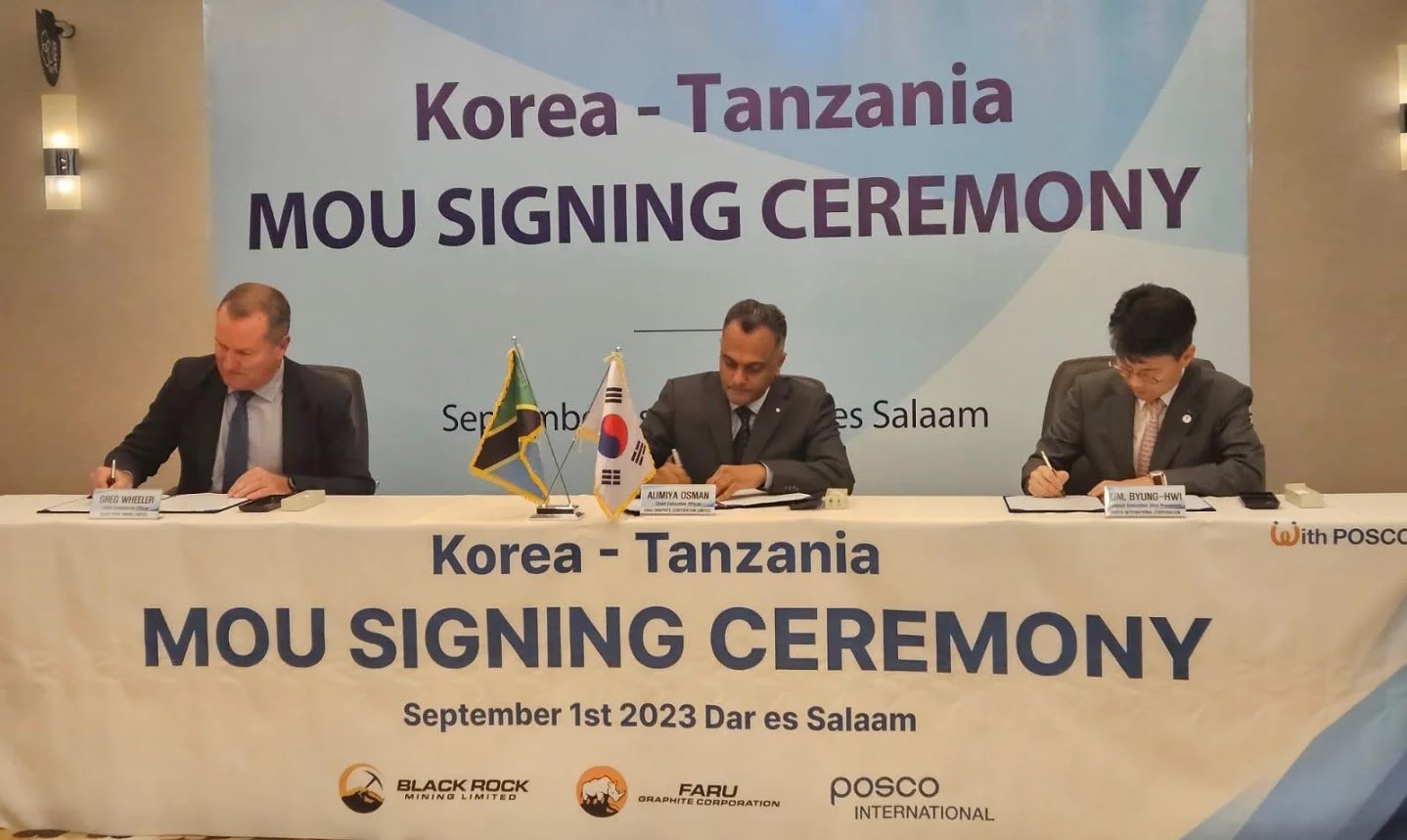
South Korea's Posco International has inked a $40 million investment agreement with Australia’s Black Rock Mining, aiming to double its graphite supply from Tanzania's Mahenge project to 60,000 tonnes per year.

As part of the deal, Posco now holds a 19.9% stake in Black Rock Mining. The investment ensures Posco early access to graphite, a crucial material for its integrated battery supply chain. The Mahenge project is set to begin construction this year, with full-scale production slated for 2026.

Last year, Posco funded the first phase of the mine’s development, securing 30,000 tonnes per year for 25 years. The new Phase 2 contract will supply an additional 30,000 tonnes annually over the same period, bringing the total to 60,000 tonnes per year.

The company plans to use non-Chinese graphite for cathode materials, aligning with the U.S. Inflation Reduction Act and the EU’s Critical Raw Materials Act, which mandate compliant raw material sourcing for electric vehicle (EV) batteries.

As China continues to curb graphite exports, Posco is leveraging reduced EV battery demand to invest in raw material assets with long-term growth potential, such as lithium and graphite.

Additionally, Posco expects to expand its graphite operations globally by securing a sales agreement with Black Rock for industrial graphite used in steel, cement, and automotive components. This could also bolster South Korea’s mineral resource security.

South Star Begins Graphite Production in Brazil Amid Growing Battery Market Demand

No comments
South Star

Canadian battery-metals company South Star has launched graphite production at its Santa Cruz project in Bahia, Brazil, with its first shipment set to leave by the end of October. The company produced an initial one metric tonne of graphite concentrate after completing the project's first phase, a milestone in South Star’s mission to become a leading supplier of battery-grade graphite amid growing demand from electric vehicle and renewable energy sectors.

Scaling to Meet Future Demand

The Santa Cruz project, which initially targets a nameplate capacity of 12,000 metric tons per year (t/yr), is set to undergo multiple expansion phases to scale output as market demand rises. The second phase, slated for 2026, is expected to bring production to 25,000t/yr, with a final phase aiming for 50,000t/yr by 2028. “As the markets and clients need more material, we are committed to meeting that demand,” said South Star’s CEO Richard Pearce, emphasizing the company’s strategy to deliver reliable, high-quality graphite concentrate to clients worldwide.

Brazil holds an advantageous position in the graphite industry, possessing one of the largest reserves globally, with an estimated 74 million tons of natural graphite, according to the US Geological Survey (USGS). In addition to its Santa Cruz project, South Star operates a graphite project in Alabama, aiming to develop a diversified, multi-asset portfolio in key markets for battery metals.

Syrah Resumes Graphite Shipments From Balama After Protest Disruptions

No comments
Syrah Resumes Graphite Shipments From Balama After Protest Disruptions
Syrah Resources

Syrah resumes graphite shipments ahead of plan after months of protests in Mozambique. The company lifted the December 2024 force majeure. It is loading 10,000t at Nacala for industrial buyers outside China. It plans a large US shipment by late September.

Balama restart and logistics

Balama returned to operation after Syrah reached a farmer agreement. The mine suffered no damage during the protests. Syrah had targeted large shipments in September–December. However, it accelerated the schedule after gaining site access in May. First-quarter sales fell 94% to 1,300t as inventories covered customers.

Implications for the anode supply chain

The restart broadens graphite supply beyond China amid policy uncertainty. Industrial buyers gain an alternative source of natural graphite flakes. EV anode projects in the US benefit from diversified feedstock. Freight through Nacala supports stable exports from northern Mozambique.

Market exposure still requires careful community engagement and security planning. Non-violent protests blocked access in September 2024. Tensions escalated after a disputed election. Effective stakeholder management now underpins Balama reliability.

Syrah resumes graphite shipments as it pivots toward North American demand. The company aims to grow sales outside China in 2025. Execution on logistics and customer qualification remains critical.

The Metalnomist Commentary

Balama’s early restart strengthens non-China graphite options for industrial and battery supply chains. Pricing power now hinges on dependable exports and stable community relations. Watch US intake and customer qualification, which will determine utilization rates this year.

Evion's India Joint Venture to Ship First Expandable Graphite Order

No comments
Evion Group Graphite

Australian graphite producer Evion has announced that its joint venture with Indian producer Metachem Manufacturing in Pune, India, is set to ship its first order of expandable graphite this month. This marks a significant milestone for the partnership and the Indian graphite market.

First Order and Production Details

The joint venture's initial order, a substantial 386 tonnes, is destined for German trading firm Technografit. Production of this order was slated to take place between January and March.  Prior to scheduled maintenance in late December, approximately 120 tonnes of the order was produced or "partially treated" from early November to mid-December. 

Evion has confirmed that the order is on track for completion and will be shipped to Europe over the coming months.  The sale price for this initial shipment averaged between $3,000 and $3,300 per tonne on a free-on-board (FOB) basis, while the joint venture anticipates production costs ranging from $1,500 to $1,750 per tonne. This healthy margin demonstrates the potential profitability of the venture.

Future Production and Expansion Plans

Evion also revealed that the joint venture has secured 500 tonnes of graphite concentrate on-site, ready for processing. This material is planned for export between April and September, primarily to European markets.  The company anticipates sales prices to be roughly 10% higher during this period.  Evion plans to provide further production guidance within the first quarter of the year, including details on new sales and buyers. 

The joint venture expects to sell over 2,000 tonnes of expandable graphite during its first full year of operations, having commenced production in April 2024.  Looking ahead, both companies are considering expanding the plant's capacity to 4,000 tonnes per year.  The original agreement establishing the joint venture had projected a production capacity of 2,000 to 2,500 tonnes per year for the initial three years. This potential expansion signals the partners' confidence in the market and their commitment to growth.

Evion Launches First Expandable Graphite Shipment from India to Europe

No comments
Evion

Australian Miner Targets 10,000 t/yr Capacity Amid Soaring EU Demand

Evion, an Australian graphite producer, has completed its first expandable graphite shipment from its joint venture (JV) facility in Pune, India. The 80-tonne cargo, delivered to European offtake partner Technografit, marks a key milestone in Evion’s plan to scale production and tap into Europe’s growing demand.

First Shipment Generates A$400,000 in Revenue

Evion’s JV, Panthera Graphite Technologies — formed with India-based Metchem Manufacturing — began production in November 2024. The JV has now shipped 80t of product, earning A$400,000, and will soon ship the remaining 306t of its first 386t sales order. The Pune facility continues to ramp up, with 500t of graphite concentrate already on site for processing in Q2 and Q3.

The company forecasts monthly shipments of 150t and monthly revenue of around A$750,000 as processing efficiencies improve.

Higher-Spec Product Orders Fetch $4,500+/t

Initial pricing averaged $3,000–3,300/t (FOB), but Panthera has received orders for higher-specification graphite priced above $4,500/t. This comes amid a global shortage of expandable graphite, a material critical to electric vehicles, batteries, aerospace, and electronics.

Evion plans to double capacity to 4,000–4,500 t/yr by year-end through its Stage 2 expansion. Stage 3 could lift capacity to 10,000 t/yr by 2026/27.

Syrah Resumes Graphite Production at Mozambique’s Balama Mine

No comments
Syrah Resumes Graphite Production at Mozambique’s Balama Mine
Syrah Resources

Restart of Graphite Operations After Protests

Syrah Resources has resumed graphite production at its Balama mine in Mozambique, with plans to restart large-scale shipments between September and December. The mine, which has a 350,000 t/yr capacity, was shut down due to prolonged protests that blocked access since late 2023.

The company declared force majeure in December, which remains active, but production is now restarting to rebuild inventories. Shipments will resume in September, targeting customers outside China as Syrah seeks to expand its global market share.

Strategic Focus on Ex-China Markets

Syrah chairman Jim Askew confirmed the company aims to increase sales from Balama this year, focusing on diversifying exports away from China. From January to March, Syrah only sold 1,300t of graphite using existing inventories, falling short of obligations.

By ramping up production, the company intends to re-establish stable supply chains and reassure buyers in key ex-China markets, including Europe and North America. This shift aligns with broader industry strategies to reduce dependence on Chinese-dominated graphite supply.

The Metalnomist Commentary

Syrah’s Balama restart underscores the volatility of global graphite supply chains amid political and social challenges in producing countries. While resuming shipments will ease near-term supply pressure, the company’s long-term success will depend on balancing local community concerns with its ambition to secure a stronger foothold in non-Chinese markets.