Showing posts sorted by relevance for query Posco. Sort by date Show all posts

Posco buys Hombre Muerto North lithium project for $62mn

No comments
Posco buys Hombre Muerto North lithium project for $62mn
Posco Lithium Project

Posco buys Hombre Muerto North lithium project for $62mn to expand its Argentine footprint. The move strengthens Posco’s brine-based LCE pipeline. As a result, Posco buys Hombre Muerto North lithium project at a strategic time.

Deal terms and project scale

Posco buys Hombre Muerto North lithium project from Lithium South under a non-binding pact. Posco Argentina agreed to acquire 100pc of the project for $62mn. The package includes five concessions and the lithium-rich brine resource. The agreement requires a 60-day due diligence period. Afterwards, both parties have 60 days to finalize a definitive deal. The project holds about 1.58mn t of brine-based LCE capacity. Forecast nameplate output stands at 15,600 t/yr.

Strategic fit in Hombre Muerto

Posco buys Hombre Muerto North lithium project near its existing Mariana asset. Posco Argentina operates the country’s only active lithium hydroxide facility. Therefore, integration could streamline brine processing and product conversion. Hombre Muerto is Argentina’s most coveted lithium basin. Rio Tinto’s Fenix project has produced lithium carbonate since the 1990s. Meanwhile, Posco’s local platform supports supply to battery value chains.

Steady drivers support the acquisition rationale. The basin offers proven brine chemistry and established logistics. The deal size suggests disciplined capital entry. However, completion depends on due diligence and final documentation. Lithium South disclosed the headline terms and timeline. Market participants will watch offtake and financing details.

The Metalnomist Commentary

This move consolidates Posco’s position in Argentina’s lithium triangle. The proximity to Mariana could reduce development risk and operating costs. Watch execution milestones and brine performance against the 15,600 t/yr target.

Posco Future M begins cathode exports to US

No comments
Posco Future M begins cathode exports to US
Posco Future M

Posco Future M begins cathode exports to US as it ships high-nickel NCM-A materials to Ultium Cells. The move uses self-produced precursors and strengthens North American EV supply chains. As a result, Posco Future M begins cathode exports to US with IRA-aligned feedstock and full upstream integration. This milestone confirms scale, quality, and localization readiness as Posco Future M begins cathode exports to US.

What shipped, from where, and to whom

Posco Future M dispatched high-nickel cathodes made with in-house precursors. Ultium Cells will use them for EV battery production. The shipment followed completion of its 45,000 t/yr precursor plant in Gwangyang. The facility started on 10 June, with first cargo on 26 July. Precursors of nickel, cobalt, and manganese combine with lithium at the Gwangyang cathode plant. The company targets consistent quality and cost control through vertical integration.

Why this matters for US battery supply chains

The delivery supports GM’s Ultium platform with non-Chinese nickel inputs. Posco Group converts nickel into high-purity nickel sulfate for CAM. Meanwhile, Posco Pilbara Lithium Solution supplies lithium from Australian spodumene. Posco Lithium Solution complements this with Argentine brine supply. These sources enhance IRA compliance and traceability for US-bound batteries. OEMs gain reduced risk, shorter timelines, and improved procurement flexibility.

Capacity outlook and localization pathway

Posco Future M and GM are building Ultium CAM in Bécancour, Quebec. The 30,000 t/yr cathode plant targets completion in 2026. Therefore, initial exports bridge near-term demand before local output ramps. The model mixes offshore precursor strength with regional CAM finishing. This approach helps stabilize costs and meet regional content rules. It also diversifies North American cathode supply beyond LFP.

The Metalnomist Commentary

Posco’s integrated precursor-to-cathode chain is a competitive advantage. Expect tighter OEM-supplier ties as IRA rules harden and Ultium volumes scale. Watch Bécancour’s CAM launch; it will set North America’s high-nickel baseline.

Posco Argentinian Lithium Projects Delayed Amid Prolonged Price Slump

No comments
Posco Argentinian Lithium Projects Delayed Amid Prolonged Price Slump
Argentinian Lithium Projects

South Korea’s Posco has delayed completion of its Argentinian lithium projects by six months, citing sluggish lithium price recovery. The Posco Argentinian lithium projects were originally set to complete Phase 2 by Q3 2025 but are now rescheduled for Q1 2026.

Phase 2 Pushed Back as Market Conditions Weaken

Posco began operating its 25,000 t/yr lithium hydroxide plant in Argentina last year. The planned Phase 2 would have doubled capacity to 50,000 t/yr through a connected upstream brine project. However, weak lithium prices and soft global demand forced a schedule revision. The company now aims to optimize production systems and ramp up Phase 1 by late 2025.

This move reflects Posco’s strategic adjustment amid a volatile market. In its April 24 report, Posco highlighted the need for operational flexibility in response to sustained pricing pressures.

Lithium Price Pressure Forces Broader Strategic Realignment

The lithium downturn also contributed to Posco ending its nickel refinery joint venture with China’s CNGR. The JV’s liquidation will complete by June, marking a retreat from previously planned upstream battery material partnerships.

Meanwhile, Posco Future M—Posco's battery materials subsidiary—posted quarterly revenue growth of 17% but a 26% decline year-on-year. Profitability rebounded modestly, helped by rising sales of high-nickel cathode active material (CAM) and growing demand for non-Chinese anode active material (AAM).

China Price Slide Highlights Global Supply Chain Fragility

Chinese lithium carbonate prices remain under pressure due to weakened demand and US-China trade tensions. As of 22 April, lithium carbonate prices dropped to ¥69,000–72,000/t ($9,463–9,874/t), extending a multi-week decline. This pricing environment complicates investment timelines and return expectations for global lithium projects.

The Metalnomist Commentary

Posco’s delay reflects broader capital discipline across the lithium sector amid persistent price volatility. With Phase 2 postponed, the company is signaling caution, while still committing to its long-term battery supply chain strategy in South America.

Posco Future M Begins Early Production of NCA Cathodes at New South Korea Plant

No comments
Posco Future M

South Korean materials giant Posco Future M, a subsidiary of the Posco conglomerate, has commenced early production at its new nickel-cobalt-aluminum (NCA) cathode plant in Pohang, North Gyeongsang province. The plant, which boasts an annual production capacity of 30,000 tonnes, was originally scheduled to begin operations in 2025 but has accelerated due to “customer requests.”

Posco’s NCA cathode output is crucial as global battery manufacturers seek high-quality cathode materials to meet demand for electric vehicles (EVs). The early start aligns with Posco Future M's 10-year agreement with Samsung SDI to supply high-nickel NCA cathodes, part of a broader push to establish South Korea as a leading player in the EV supply chain.

Expanding Production Capacity Amid EV Market Challenges

Posco Future M is actively expanding its cathode production capabilities with another plant under construction in Gwangyang, South Jeolla province, which is expected to add 52,500 tonnes per year by 2026. This will bring the company's total cathode material production capacity to 248,500 tonnes per year across its two plants by 2026. Despite this expansion, the firm has revised its initial target of 320,000 tonnes by 2025, reflecting the current slowdown in the global EV market.

The slowdown has also impacted Posco’s joint ventures and new plant projects. In September, the company postponed its plans for a nickel sulfate and battery precursor plant with China’s Huayou Cobalt, as well as its high-nickel cathode active material (CAM) facility in Quebec, Canada, a joint effort with General Motors, citing “local conditions.”

CNGR to End Investment in Nickel Joint Venture with Posco Amid Weak EV Market

No comments
Posco

China’s CNGR will liquidate its joint venture with South Korea’s Posco due to slowing electric vehicle demand.

Chinese battery materials producer CNGR has decided to terminate its investment in a nickel refinery joint venture with South Korea’s Posco Holdings. The joint venture, Posco CNGR Nickel Solution, will be liquidated as part of CNGR’s efforts to reduce investment risks and protect investor interests. This decision comes amid a slowdown in the global electric vehicle (EV) market, which has impacted the demand for battery materials.

Slowing EV Demand Leads to Strategic Adjustments

The global EV market has seen slower growth in 2024 compared to the previous year, which has affected the demand for battery materials like nickel and lithium. According to South Korean market intelligence firm SNE Research, the slowdown in EV sales has resulted in reduced battery installations. This trend prompted CNGR to reassess its joint venture with Posco, leading to the decision to dissolve the partnership.

Joint Venture and Production Facility Plans

CNGR and Posco first announced their joint venture plans in June 2023, aiming to build a production facility in Pohang, South Korea. The facility was designed to produce 50,000 tonnes per year of nickel sulphate and 110,000 tonnes per year of lithium-ion battery precursors. The plant was expected to support the production of batteries for 1.2 million EVs. However, with the weakening EV market, CNGR has chosen to withdraw from the venture to avoid further exposure to the slowing demand.

Conclusion

The termination of the joint venture with Posco marks a strategic shift for CNGR in response to the challenges facing the EV market. As demand for EVs continues to fluctuate, companies in the battery materials sector are re-evaluating their investments to mitigate risks and ensure financial stability.

Posco Invests $40 Million in Black Rock's Tanzanian Graphite Project

No comments

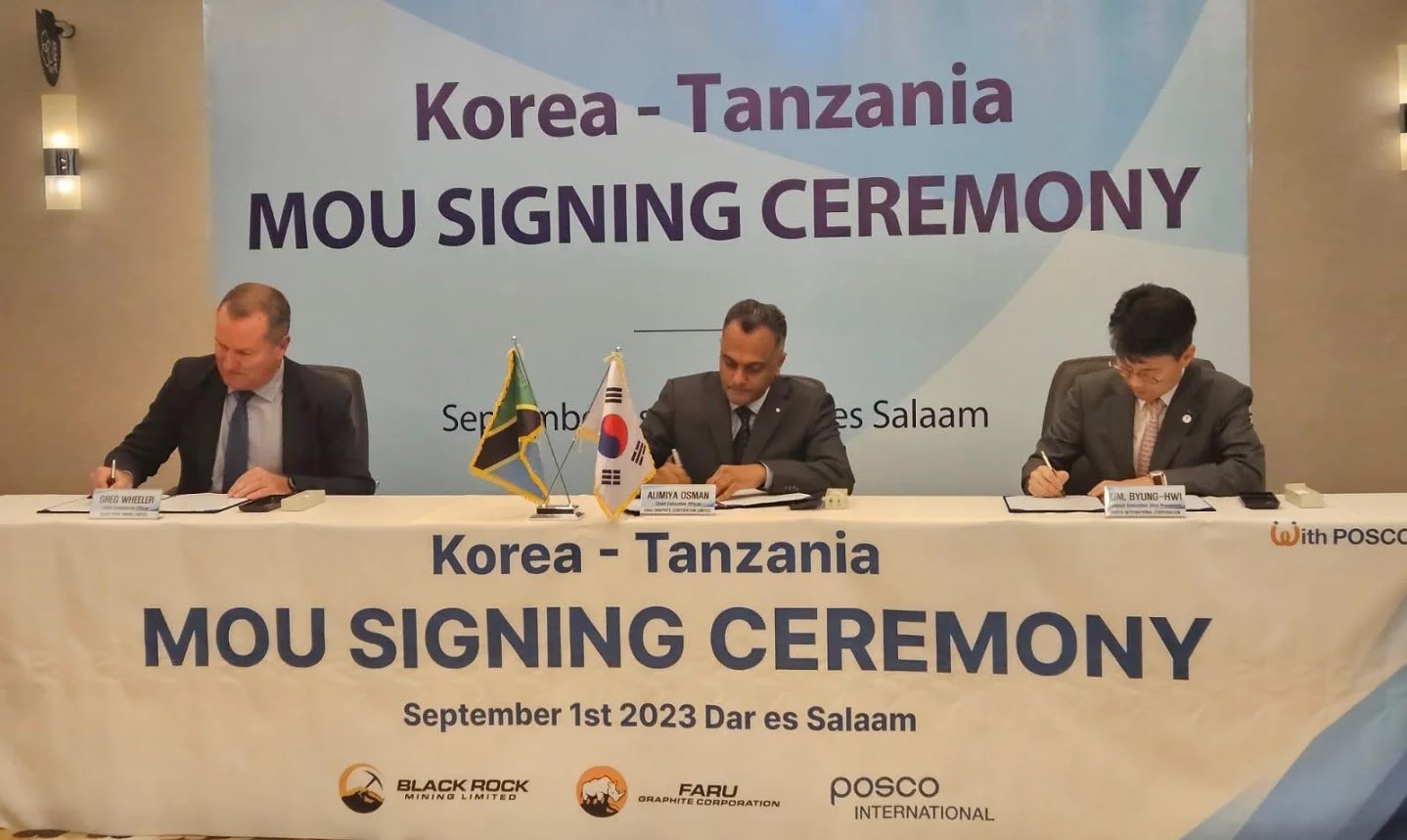
South Korea's Posco International has inked a $40 million investment agreement with Australia’s Black Rock Mining, aiming to double its graphite supply from Tanzania's Mahenge project to 60,000 tonnes per year.

As part of the deal, Posco now holds a 19.9% stake in Black Rock Mining. The investment ensures Posco early access to graphite, a crucial material for its integrated battery supply chain. The Mahenge project is set to begin construction this year, with full-scale production slated for 2026.

Last year, Posco funded the first phase of the mine’s development, securing 30,000 tonnes per year for 25 years. The new Phase 2 contract will supply an additional 30,000 tonnes annually over the same period, bringing the total to 60,000 tonnes per year.

The company plans to use non-Chinese graphite for cathode materials, aligning with the U.S. Inflation Reduction Act and the EU’s Critical Raw Materials Act, which mandate compliant raw material sourcing for electric vehicle (EV) batteries.

As China continues to curb graphite exports, Posco is leveraging reduced EV battery demand to invest in raw material assets with long-term growth potential, such as lithium and graphite.

Additionally, Posco expects to expand its graphite operations globally by securing a sales agreement with Black Rock for industrial graphite used in steel, cement, and automotive components. This could also bolster South Korea’s mineral resource security.

Posco and Hancock Prospecting to Construct New Lithium Plant

No comments
Hancock Prospecting

In an ambitious move to secure a more robust lithium supply chain, South Korean steelmaker Posco, in partnership with Australia’s Hancock Prospecting, has announced plans to build a 30,000 metric tonne per year lithium processing plant. The exact location of the plant is still under deliberation, with potential sites being evaluated in various countries, including South Korea.

Strategic Expansion in Lithium Sector

The collaboration between Posco and Hancock is a strategic step to bypass US Foreign Entity of Concern (FEoC) regulations and solidify Posco's standing in the lithium value chain. Posco’s plan is to manage a full spectrum from mining and extraction from salt lakes to producing lithium hydroxide and cathode materials, and eventually recycling them. This comprehensive approach aims to fortify its supply chain amidst growing demand for lithium, primarily driven by the electric vehicle and renewable energy sectors.

Global Partnerships and Investments

Both Posco and Hancock are not new to the lithium industry. Hancock holds a 19.9% stake in Liontown Resources, an Australian lithium developer. Posco has been extending its reach in the lithium market through various international partnerships, including joint ventures with Pilbara Minerals in Australia and an investment in the Sal de Ora brine project in Argentina’s Salar del Hombre Muerto.

These ventures underline both companies' commitment to strengthening their positions within the global lithium market, which is expected to grow significantly due to the increasing emphasis on sustainable and renewable energy resources.

Energy Fuels and Posco Forge Rare Earth Partnership for EV Supply Chain

No comments
Energy Fuels

Deal Could Power Over 30,000 EVs and Reduce Dependence on Chinese Rare Earths

U.S.-Korea Pact Targets EV Magnet Materials

U.S. rare earths producer Energy Fuels has entered a strategic agreement with South Korea’s Posco International to supply neodymium-praseodymium (NdPr) oxide. The material is essential for permanent magnets used in electric vehicle (EV) and hybrid electric vehicle (HEV) drivetrains.

Energy Fuels recently shipped NdPr samples to Posco, which will test them for use in magnet alloy and metal manufacturing. These magnets will be integrated into traction motor cores supplied to automakers across the U.S., Europe, South Korea, and Japan.

Pending successful validation, Energy Fuels and Posco intend to sign a commercial supply agreement. This deal would cover enough NdPr to support magnets for over 30,000 EVs annually, potentially expanding into a longer-term production partnership.

Rare Earth Diversification Strategy Gains Momentum

The collaboration marks a step forward in diversifying the global rare earth supply chain, which remains heavily dominated by China. According to the U.S. Geological Survey, China produced 69%—around 270,000 metric tonnes—of global rare earth ore in 2024.

Energy Fuels aims to challenge that dominance by expanding its rare earth production capacity. The company operates its White Mesa Mill in Utah, producing oxides from monazite concentrates sourced as a by-product of heavy mineral sands.

The company currently has a capacity of 1,000 t/yr for NdPr oxide and plans to scale this up to between 4,000–6,000 t/yr. Future expansions will also include additional rare earth elements such as dysprosium and terbium, which are crucial for high-temperature magnet performance in EVs.

ReElement produces high purity samarium for samarium-cobalt magnets

No comments
ReElement produces high purity samarium for samarium-cobalt magnets
ReElement

ReElement produces high purity samarium at minimum 99.9pc from recycled and ore-based feedstocks. ReElement produces high purity samarium as it targets commercial-scale output for defense and industrial markets. Therefore, the company is positioning samarium supply as a strategic input for samarium-cobalt magnet manufacturing.

ReElement produces high purity samarium with a clear focus on applications that need heat and corrosion stability. Samarium-cobalt magnets serve aircraft systems, munitions, communications hardware, and high-reliability motors. Meanwhile, buyers are tightening qualification requirements for rare earth oxides as supply security becomes part of procurement.

Why samarium-cobalt magnets matter in defense supply chains

Samarium-cobalt magnets matter because they hold magnetic strength at higher temperatures than many alternatives. Defense and aerospace platforms often operate near thermal limits. As a result, magnet makers prioritize consistent chemistry, low impurities, and dependable batch-to-batch performance.

Samarium also plays a niche but critical role in high-reliability electronics and actuators. That niche creates a leverage point for refiners that can deliver tight specs. However, commercial scale matters because qualification alone does not stabilize supply.

Partnerships signal a push toward integrated US magnet production

ReElement operates facilities in Indiana and is building a network around magnet recycling and refining. The company has an agreement with US magnet producer Vulcan Elements to process end-of-life magnets, e-waste, and concentrates into high-purity rare earth oxides. As a result, ReElement can pair recycled feedstocks with ore-based streams to smooth input variability.

ReElement also plans a larger integrated rare-earth and permanent magnet production complex with South Korean firm Posco. Posco will handle sourcing and magnet production, while ReElement will provide separation, refining, and recycling technology. Meanwhile, ReElement expects production expansion at its Marion facility and partner sites in 2026.

The Metalnomist Commentary

This announcement is less about one oxide and more about qualification momentum for an integrated magnet value chain. However, ReElement must prove throughput, yields, and cost control to sustain commercial contracts. The winners will be the teams that lock feedstock, scale refining, and keep quality stable under volume.

Honda Ontario EV Plan Suspended Amid Slower Market Growth Projections

No comments
Honda Ontario EV Plan Suspended Amid Slower Market Growth Projections
Honda EV

Honda suspended its ambitious C$15 billion ($10.7 billion) Honda Ontario EV plan to build a comprehensive electric vehicle value chain in Canada. Chief Executive Toshihiro Mibe announced the two-year delay during the company's first-quarter earnings presentation, citing slower-than-expected EV market growth. The Honda Ontario EV plan postponement represents a significant setback for Canada's battery materials supply chain development and critical mineral processing ambitions.

Comprehensive Battery Supply Chain Project Faces Market Reality

The Honda Ontario EV plan encompassed a complete electric vehicle manufacturing ecosystem in Alliston, Ontario, including an EV assembly plant and standalone battery manufacturing facility. Honda partnered with Posco Future M to develop cathode and precursor materials facilities while collaborating with Asahi Kasei on separator plant construction. Meanwhile, this integrated approach aimed to reduce supply chain dependencies while supporting Honda's goal of 100% battery and fuel cell EV sales by 2040.

The comprehensive nature of the Honda Ontario EV plan positioned Canada as a strategic hub for North American electric vehicle production. Honda's investment would have created substantial demand for Canadian critical minerals, particularly lithium, nickel, and cobalt for battery cathode materials. However, slower market adoption rates have forced automakers to reassess their aggressive electrification timelines and associated capital investments.

Critical Mineral Processing Ambitions Face Automotive Headwinds

Canada's strategy to capture value from its abundant critical mineral resources through downstream processing suffers a major blow from the Honda Ontario EV plan suspension. The project represented a key opportunity to establish domestic battery materials manufacturing capabilities using Canadian lithium, nickel, and graphite resources. As a result, the delay undermines government efforts to build integrated critical mineral supply chains within North America.

Posco Future M's planned cathode and precursor facilities would have processed Canadian-sourced critical minerals into high-value battery materials for Honda's EV production. The partnership promised technology transfer and manufacturing expertise to establish Canada's position in global battery supply chains. Therefore, the Honda Ontario EV plan postponement reduces near-term demand prospects for Canadian critical mineral producers seeking domestic processing partnerships.

The two-year delay reflects broader challenges facing automaker electrification strategies as consumer adoption lags initial projections. Honda joins other manufacturers reassessing EV investment timelines amid market uncertainty and profitability concerns. Consequently, critical mineral demand growth may moderate as automakers adjust production capacity plans to match actual market conditions.

The Metalnomist Commentary

Honda's decision to pause its massive Ontario investment reflects the gap between aggressive EV transition rhetoric and market reality, highlighting risks for critical mineral producers banking on rapid battery demand growth. This setback underscores the importance of diversified demand strategies for Canadian critical mineral projects, as automotive electrification timelines prove more volatile than anticipated across the industry.

Anson lithium offtake deal with LG anchors US brine project

No comments
Anson lithium offtake deal with LG anchors US brine project
Anson Resources

Anson lithium offtake deal with LG Energy Solution marks a major step for US brine-based lithium supply. Under the Anson lithium offtake deal, LG Energy Solution will purchase 4,000 t/yr of battery-grade lithium carbonate from 2028. This Anson lithium offtake deal secures 40pc of planned nameplate output at the Green River project in Utah’s Paradox Basin.

Offtake secures long-term demand for Green River lithium

The Anson lithium offtake deal gives the Green River brine project a strong anchor customer before construction is complete. Pricing will follow a market-linked formula, aligning contract economics with prevailing battery-grade lithium carbonate prices. As a result, Anson can reduce price risk while still capturing upside in tighter markets.

Meanwhile, the five-year contract, plus an option for another five years, offers rare visibility on future cash flows. LG Energy Solution secures North American lithium carbonate to support its global cell manufacturing footprint. For Anson, this agreement strengthens its bankability as it finalises project financing and engineering.

Fast-track permitting for Green River is reportedly 90pc complete, which should shorten the path to first production. Therefore, the offtake timing from 2028 fits with Anson’s development schedule and gives lenders confidence in future sales volumes.

Korean partnerships deepen technology and market access

The offtake with LG builds on Anson’s earlier link-up with South Korea’s Posco on direct lithium extraction. Under a non-binding agreement, Posco will help build a demonstration plant to test DLE technology at Green River. This Korean axis could give Anson both advanced process technology and long-term market access in Asia.

At the same time, the royalty framework with the Utah government, scaled between 1–5pc, ties state revenues to market conditions. This structure can help align public and private interests through the commodity cycle. If prices strengthen, Utah benefits more, while Anson keeps flexibility during weaker periods.

In strategic terms, Green River’s brine resource adds another US-based option as automakers seek to diversify away from traditional hard-rock supply chains. With LG Energy Solution locked in, the project moves from concept to a credible node in regional battery materials infrastructure.

The Metalnomist Commentary

This offtake shows how mid-tier developers can de-risk brine projects by securing blue-chip battery customers early. If Anson delivers on DLE performance and schedule, Green River could become a template for future US brine developments. However, capex inflation, technology execution and permitting timelines will still determine whether contracted volumes translate into reliable long-term supply.

Foreign investment accelerates Turkey stainless steel growth as re-rolling hub emerges

No comments
Foreign investment accelerates Turkey stainless steel growth as re-rolling hub emerges
Stainless Steel

Turkey stainless steel growth is reshaping the country from a net importer into a re-rolling and processing hub. Turkey stainless steel growth is driven by foreign investment, shifting trade flows and a policy push to protect local value addition. As a result, Turkey stainless steel growth now sits at the centre of regional stainless supply chains.

Foreign investors underpin Turkey stainless steel growth

Turkey has become the only major stainless consumer without melting capacity, yet it plays a growing trade role. The country still imports all flat and semi-finished stainless products, but its position in re-rolling and processing continues to strengthen. Imports of flat-rolled stainless not further worked than hot-rolled reached about 250,000t in 2024, up by 15pc on the year.

However, imports of hot-rolled and cold-rolled flat products fell by around 8pc to below 70,000t, showing more local processing. Exports of flat-rolled stainless fell to just over 100,000t in 2024, down from 230,000t in 2022. This export drop partly reflects stronger domestic stainless consumption after the 2023 earthquake and more onshore value retention.

Foreign capital sits at the heart of Turkey stainless steel growth. Posco’s Assan TST remains the largest local cold-rolled stainless producer and has delivered more than 2mn t since 2013. Taiwan’s YC INOX added a 4,000 t/month tube operation in 2022, with pickling capacity that allows direct use of hot-rolled semi-finished feed. These investments reduce reliance on imported finished products and lift Turkey’s role in regional supply chains.

Policy protection and new projects reinforce Turkey stainless steel growth

New capacity plans will further expand Turkey stainless steel growth over the next decade. China’s Yongjin Technology plans a 400,000 t/yr cold-rolling mill at Yalova, targeting completion in 2027. Domestic service centre Saritas Celik Sanayi ve Ticaret AS aims for an 800,000 t/yr stainless facility in four phases, with 400,000 t/yr of cold-rolled capacity expected online from 2027.

Ankara is matching this investment wave with trade defence tools to shield Turkey stainless steel growth. The government raised import duties on cold-rolled stainless steel coil from 8pc to 12pc in December 2023. At the same time, it cut duty on stainless plate to zero and kept hot-rolled coil duties at 2pc, encouraging inbound semi-finished feed for further processing.

Turkey has also launched anti-dumping investigations to guard its expanding base. Authorities are probing imports of cold-rolled plate and coil from Indonesia and China following complaints from Posco Assan TST and Celik Sanayi. Existing anti-dumping duties on welded stainless tubes from China and Taiwan were extended by five years in June. Higher rates apply to most suppliers, with reduced duties for a few named producers such as Foshan Vinmay and YC INOX. These measures aim to preserve margins for local processors as Turkey stainless steel growth accelerates.

The Metalnomist Commentary

Turkey’s stainless sector is evolving into a classic “no-melt, high-processing” model backed by Asian and domestic capital. If trade defence remains targeted and predictable, Turkey can deepen its hub role without triggering severe retaliation or supply distortions. The next test will be whether planned capacities absorb regional demand or ignite a new wave of competitive exports.

LGES Exits Indonesia EV Battery Project Amid Strategic Shift

No comments
LGES Exits Indonesia EV Battery Project Amid Strategic Shift
LGES

LGES exits Indonesia EV project

LGES exits Indonesia EV project, marking a significant shift in its global battery strategy.
South Korea’s LG Energy Solution (LGES) has officially withdrawn from Indonesia’s $8.4 billion Grand Package EV battery initiative.

The project originally included LGES, LG Chem, Posco Future M, Huayou, Antam, and Indonesia Battery Corporation. Plans had outlined a complete value chain: from mining and smelting to precursor, cathode, and battery cell production.

Strategic Refocus on Core Ventures and Energy Storage

LGES exits Indonesia EV project while reaffirming its commitment to the HLI Green Power joint venture with Hyundai Motor. This Indonesian JV plant has a 10 GWh annual battery cell capacity and began mass production in April 2024.

Meanwhile, LGES continues to diversify beyond the EV battery sector. It has secured energy storage system (ESS) battery contracts with Delta Electronics in Taiwan and PGE in Poland.

Indonesia Presence Maintained Through LFP and JV Assets

Despite the LGES exit from the Indonesia EV project, the company retains stakes in key Indonesian operations. Earlier this year, LGES invested in a lithium iron phosphate (LFP) cathode plant with China’s Lopal Tech.

LGES emphasized its intent to continue collaboration with the Indonesian government, particularly via its joint venture HLI Green Power. This signals a strategic recalibration rather than a full-scale withdrawal from the Indonesian battery ecosystem.

The Metalnomist Commentary

LGES’s departure reflects a broader recalibration of battery majors toward diversified revenue streams and scalable ESS markets. The company’s sustained Indonesian footprint suggests long-term positioning, albeit through leaner, more focused partnerships.

MMP nickel matte supply to China rises with new East Kalimantan smelter

No comments
MMP nickel matte supply to China rises with new East Kalimantan smelter
Mitra Murni Perkasa

MMP nickel matte supply to China will increase after production began on 26 June. Indonesia’s first domestically owned nickel producer started high-grade nickel matte in Kariangau. The RKEF smelter is designed for 28,000 t per year of HGNM. The nickel content exceeds 70 percent, above typical Indonesian grades.

Capacity, technology, and upstream integration

MMP nickel matte supply to China benefits from fully domestic funding and ownership. The project supports Indonesia’s battery supply-chain ambitions and energy transition goals. Chinese EPC firm ENFI built the plant under a 2023 agreement. ENFI is also constructing a 52,000 t per year HGNM project for Posco. Therefore, regional engineering depth should aid reliability and ramp-up.

Market context, pricing, and feedstock choices

China imported about 194,641 t of nickel matte in January–May, up 42 percent year on year. Indonesia supplied roughly 85.6 percent of those volumes. However, offers paused in June amid thin margins, then resumed in early July. Downstream users still view MHP as more cost-effective than HGNM. As a result, smelter premiums will track rival feedstock economics.

MMP nickel matte supply to China could stabilize feed for converters and battery precursors. Meanwhile, higher HGNM grade may improve unit transport and refining economics. Yet pricing must compete with MHP and intermediates tied to sulfate routes. Therefore, offtake terms and sulfuric acid balances will be closely watched.

The Metalnomist Commentary

MMP adds a domestically funded node to Indonesia’s nickel value chain and China’s feed security. The commercial test will be margins versus MHP and contract flexibility. Watch ENFI’s execution, blending strategies, and delivered costs into coastal China.

Ultium LFP battery production in Tennessee to expand GM’s EV portfolio

No comments
Ultium LFP battery production in Tennessee to expand GM’s EV portfolio
Ultium Cells

Ultium LFP battery production in Tennessee will start by late 2027. GM and LG Energy Solution will convert lines at Spring Hill. Ultium LFP battery production in Tennessee will lower costs for mass-market EVs. The shift complements high-nickel and future lithium-manganese chemistries.

Capacity strategy and plant network

Ultium’s Ohio plant will keep making NCMA cells for long-range crossovers. GM and Samsung SDI are building a 36 GWh plant in Indiana. Mass production there targets 2027. Together, these sites diversify chemistries and sourcing. Ultium LFP battery production in Tennessee strengthens North American cell optionality.

Market outlook and supply chain integration

U.S. incentives favor localized cells and materials. GM sold 78,200 EVs in the first half. Its estimated EV share reached about 13 percent. GM sources lithium carbonate from Thacker Pass and CAM via POSCO Future M. Ultium LFP battery production in Tennessee will fit this integrated ecosystem. The Lansing stake sale to LGES sharpened capital focus.

The Metalnomist Commentary

GM is pragmatically adding lower-cost LFP alongside premium chemistries. Execution hinges on line conversion, yield ramp, and firm offtake. Watch IRA eligibility, precursor sourcing, and fleet demand into 2027.

Australia's Lithium Concentrate Exports Surge in First Half of 2024

No comments

Australia's lithium concentrate (spodumene) exports saw a significant increase in the first half of 2024, reaching approximately 1.94 million metric tons. This growth was largely driven by robust demand in the second quarter, particularly from South Korea and Indonesia, as they began to ramp up their imports of Australian lithium supplies.

From April to June, exports surged by 49% year-over-year to 1.26 million tons, contributing to a 9.9% rise in total first-half shipments, according to data from the Australian Bureau of Statistics. China remained the dominant importer, accounting for nearly 95% of Australia's lithium concentrate exports, with volumes rising by 4.6% to 1.84 million tons. This surge is closely tied to China's continued growth in new energy vehicle (NEV) sales and production, which remains strong despite global concerns about slowing electric vehicle (EV) growth in other regions such as Europe and the United States.

South Korea's imports of spodumene experienced a dramatic increase, rising to 71,441 tons in the first half of the year from just 1,240 tons a year earlier. This spike follows the completion of the country's first lithium hydroxide plant late last year, which has since started production. The plant, a joint venture between Australian lithium producer Pilbara Minerals and South Korean conglomerate Posco, delivered its first lithium hydroxide order in April.

Indonesia also saw a sharp increase in spodumene imports, reaching 25,098 tons from a mere 60 tons the previous year. This growth coincides with the launch of pilot production at a lithium plant in Indonesia by Chinese lithium salts producer Chengxin Lithium, which extracts lithium from hard rock ores.

Despite these gains, the lithium market faces challenges. While most Australian lithium producers reported higher spodumene output in the second quarter—including companies like Pilbara Minerals, Mineral Resources, and Core Lithium—Core Lithium has paused its processing operations since June due to the weak lithium market conditions.

Australia's lithium concentrate exports (t)


* Source : Australian Bureau of Statistics

Chile Rio Tinto Lithium Deposit Partnership Secures Largest Undeveloped Resource

No comments
Chile Rio Tinto Lithium Deposit Partnership Secures Largest Undeveloped Resource
Chile Rio Tinto

Chile Rio Tinto lithium deposit partnership emerged as Chile's national mining company Enami selected the Anglo-Australian miner to explore and develop the Altoandinos project, the country's largest undeveloped lithium deposit. The Chile Rio Tinto lithium deposit agreement establishes a public-private concession with Rio Tinto holding 51% ownership while Enami retains 49%, representing a combined $3 billion investment where Rio Tinto contributes $425 million for access to over 15 million tonnes of lithium carbonate equivalent resources.

Competitive Selection Process Validates Rio Tinto's Technology Leadership

Chile Rio Tinto lithium deposit selection followed Enami's unanimous board decision choosing Rio Tinto from a competitive pool including China's BYD, France's Eramet, and South Korea's Posco. Rio Tinto's proprietary direct lithium extraction (DLE) technology provided the decisive advantage, offering faster and more environmentally friendly operations compared to traditional evaporation methods. The DLE approach eliminates brine evaporation requirements while accelerating production timelines and reducing environmental impact.

Meanwhile, Rio Tinto's Rincon plant in Argentina serves as a demonstration and pilot facility for Chilean operations since both brine deposits share similar chemical compositions. This existing operational experience provides technical validation and reduces development risks for the Altoandinos project. Rio Tinto will assume complete operational responsibility while financing the project through financial operation and contributing to pre-feasibility study expenses.

Massive Resource Scale Supports 75,000 Tonne Annual Production

However, the Altoandinos salt flat contains substantial lithium resources exceeding 15 million tonnes of lithium carbonate equivalent with production capacity reaching 75,000 tonnes annually according to Enami projections. This production scale positions the project among global lithium industry leaders while supporting Chile's strategic objectives for lithium sector development. The resource magnitude justifies the $3 billion investment commitment from both partnership participants.

Therefore, the project timeline remains under development with no specific operational start date announced pending pre-feasibility study completion and regulatory approvals. The comprehensive development approach ensures technical optimization while addressing environmental and social considerations essential for sustainable lithium extraction. Rio Tinto's operational expertise combined with Enami's local knowledge creates optimal conditions for successful project implementation.

Strategic Expansion Reinforces Chile Lithium Market Leadership

Furthermore, the Altoandinos partnership follows Rio Tinto's recent selection by Chilean copper giant Codelco for the Maricunga salt flat exploration, representing Chile's second-largest undeveloped lithium deposit. This dual partnership positioning demonstrates Rio Tinto's strategic commitment to Chilean lithium development while reinforcing Chile's global lithium market leadership. The concurrent projects create synergies for technology deployment and operational efficiency.

As a result, Chile strengthens its position as the world's premier lithium jurisdiction through strategic partnerships with established international miners possessing advanced extraction technologies. The public-private partnership model enables state participation in resource development while leveraging private sector expertise and capital. This approach maximizes economic benefits while maintaining national control over strategic mineral resources essential for global energy transition.

The Metalnomist Commentary

Chile's selection of Rio Tinto for both the Altoandinos and Maricunga lithium projects demonstrates sophisticated resource development strategy that prioritizes advanced extraction technology and environmental sustainability over purely financial considerations. The emphasis on direct lithium extraction capabilities reflects Chile's commitment to maintaining global lithium leadership through technological innovation, particularly important as competition intensifies from emerging producers in Argentina, Australia, and other jurisdictions seeking market share.

Pilbara Minerals and Calix Restart WA Lithium Phosphate Project with Government Backing

No comments
Pilbara Minerals

Mid-Stream Plant to Strengthen Australia’s Downstream Lithium Supply Chain by Late 2025

Pilbara Minerals and Calix have resumed development of their mid-stream renewable lithium phosphate demonstration plant in Western Australia, following a major funding boost from the state government. The project, paused in October 2024 due to funding constraints, restarted after a A$15 million (US$9.4 million) grant was awarded in December.

Now 75% complete, the facility will produce 3,000 tonnes per year (t/yr) of lithium phosphate, using spodumene feedstock from Pilbara’s Pilgangoora lithium mine. Commissioning is targeted between October and December 2025, with the project serving as a key step in advancing Australia’s mid-stream lithium processing capabilities.

Strategic Incentives Set Stage for Long-Term Lithium Refining Growth

This mid-stream facility will qualify for new tax incentives, offering 10% rebates on processing and refining costs for a ten-year period starting in 2027. These incentives, legislated by Australia’s federal government, aim to increase domestic value-added production in critical minerals.

Additionally, the Western Australian government has granted two-year waivers on administrative and port fees, further lowering the project's financial barriers. These measures reflect coordinated efforts by state and federal authorities to stimulate downstream investment amid fluctuating global lithium prices.

Pilbara Expands Global Processing Footprint Amid Market Volatility

The joint venture aligns with Pilbara Minerals broader strategy to expand its downstream presence. The company already operates a lithium hydroxide plant in Gwangyang, South Korea, in partnership with POSCO, one of the world's largest steel producers.

By partnering with Calix, a leader in low-emission calcination technology, Pilbara aims to produce battery-grade lithium chemicals with lower carbon intensity. The demonstration project will not only support Australia's domestic battery supply chain but could serve as a template for future commercial-scale operations.

Chile Shortlists Partners for Altoandinos Lithium Project

No comments

Chile's state-owned mining company Enami is set to negotiate with six shortlisted firms to form a public-private partnership for its Salares Altoandinos lithium project in the Atacama region. The selected companies include China's BYD and CNGR, South Korea's LG Energy Solution and Posco, France's Eramet, and Australia's Rio Tinto.

Public-Private Partnership and Project Goals

The six contenders were chosen from an initial pool of twelve interested parties. Enami plans to share results from its $10.5 million exploration program, which will resume in September, during negotiations. Discussions with local indigenous groups are also in progress. Enami aims to finalize partnerships by March 2025, aligning with Chile's national strategy to double lithium production over the next decade.

Syrah Graphite Offtake Supports Non-China Anode Supply Chain Strategy

No comments
Syrah Graphite Offtake Supports Non-China Anode Supply Chain Strategy
Syrah resources

Syrah graphite offtake plans with NextSource Materials could strengthen non-China graphite supply routes for battery anode production. The Australian producer may sell 34,000-68,000t of natural graphite fines over seven years, subject to commercial production at NextSource’s planned Abu Dhabi anode material plant.

The Syrah graphite offtake agreement depends on several conditions. NextSource has not yet made a final investment decision on the Abu Dhabi project, and both NextSource and its customers must approve the use of Syrah’s graphite fines. This makes the deal strategically important, but still dependent on qualification, financing, and project execution.

Syrah will supply the material from its Balama graphite mine in Mozambique. The mine produced 34,400t of natural graphite in October-December 2025, up from 25,700t in the previous quarter and no production a year earlier.

Balama Graphite Gains Value as Buyers Seek Supply Diversity

Balama graphite is becoming more important as battery supply chains seek alternatives to China-linked material flows. Syrah said the NextSource agreement prices Balama graphite at a premium to market indices, suggesting that qualified non-China supply is gaining strategic value.

Syrah’s average realised graphite price, including fines and coarse flakes, rose by 11pc year on year to $506/t fob Nacala in October-December 2025. Higher realised pricing supports the company’s effort to rebuild sales momentum after production interruptions and weak market conditions.

The deal also fits Syrah’s long-standing plan to increase graphite sales outside China. The company signed a six-year offtake agreement with South Korean producer Posco in 2024 and agreed to supply graphite to US producers Graphex Technologies and Westwater in 2023.

Graphite Trade Restrictions Increase Supply Chain Urgency

Graphite is moving deeper into the critical minerals policy debate because it is essential for lithium-ion battery anodes. China remains dominant in graphite processing, so automakers, battery makers, and governments are trying to develop alternative sources of feedstock and anode material production.

NextSource’s planned Abu Dhabi anode material plant could add a new processing node outside China if it reaches commercial production. Syrah’s graphite fines would provide feedstock for that strategy, while Mozambique would remain an important upstream source.

The timing matters because graphite trade restrictions are increasing. China recently banned sales of dual-use products, including graphite, to some Japanese producers. This reinforces the need for diversified supply chains that can connect African mine output, Middle Eastern processing, and battery customers in allied markets.

The Metalnomist Commentary

The Syrah-NextSource agreement shows that graphite supply security now depends on qualification pathways, not only mine output. Non-China anode supply chains will need reliable feedstock, bankable processing projects, and customers willing to pay for geopolitical resilience.