Showing posts sorted by relevance for query graphite mining. Sort by date Show all posts

China Graphite Spherical Graphite Output Falls as Natural Anode Demand Weakens

No comments
China Graphite Spherical Graphite Output Falls as Natural Anode Demand Weakens
China Graphite Group

China Graphite spherical graphite output fell in 2025 as weak demand from the natural graphite anode material sector and existing inventories pressured production. The Hong Kong-listed natural graphite producer produced 2,300t of spherical graphite during the year, down 28% from 2024.

The decline reflects a broader shift in China’s anode materials market. Battery producers are still expanding overall anode consumption, but natural graphite is losing share to artificial graphite because of performance and price competition.

China Graphite spherical graphite output weakness shows that battery material growth does not benefit all feedstock routes equally. Natural graphite remains important, but artificial anode materials are gaining ground because they offer stronger cycling life and rate performance for many lithium-ion battery applications.

Spherical graphite sales also fell in 2025, although less sharply than production. China Graphite sold 5,815t of spherical graphite, down 6.9% from a year earlier, suggesting the company partly relied on existing inventory to meet demand.

Artificial Graphite Competition Pressures Natural Anode Feedstock

China’s anode material shipments rose strongly in 2025, reaching 2.9mn t, up 39% from a year earlier. However, natural graphite anode materials moved in the opposite direction.

Natural graphite anode shipments fell to 210,000t in 2025, down 19% from the previous year. Their share of China’s total anode material shipments dropped to 7.2%, showing that natural graphite is becoming a smaller part of the domestic anode mix.

This matters directly for spherical graphite producers. Spherical graphite is a key processed feedstock for natural graphite anode materials. When natural anode production slows, spherical graphite demand weakens quickly.

China Graphite attributed the decline to price competition and lower output of natural graphite anode materials. The company also pointed to the shorter cycling life and weaker rate performance of natural graphite compared with artificial anode materials.

Artificial graphite has become dominant in China’s battery supply chain because many battery makers prioritise consistency, fast charging performance and long cycle life. These factors are especially important for electric vehicles and energy storage systems.

The result is a margin squeeze for natural graphite processors. Even when total battery demand grows, spherical graphite producers must compete against artificial graphite suppliers that are more closely aligned with mainstream cell performance requirements.

Flake Graphite Output Rises Despite Spherical Graphite Weakness

China Graphite’s upstream natural graphite flake business performed better than its spherical graphite segment. The company produced 57,600t of natural graphite flake in 2025, up 10.8% from a year earlier.

The increase was supported by equipment upgrades, showing that China Graphite improved mining or processing efficiency even as downstream spherical graphite demand weakened. Flake graphite sales also edged higher by 1.3% to 46,020t.

This creates a mixed operating picture. Upstream flake output increased, but downstream spherical graphite production fell sharply. The gap suggests that the company may need to manage feedstock allocation carefully if natural anode demand remains weak.

Natural graphite still has strategic value. It can support lower-cost anode production and remains important for battery supply-chain diversification. However, its competitiveness depends on purification, coating, consistency, performance and customer qualification.

For China Graphite, the next challenge is not only producing more flake graphite. It must defend its position in higher-value downstream graphite products as the anode market shifts toward artificial materials and more demanding battery specifications.

The company’s results also highlight a wider issue for natural graphite markets. Supply growth alone is not enough. Producers need downstream demand from qualified anode makers, battery customers and applications where natural graphite retains a cost or performance advantage.

The Metalnomist Commentary

China Graphite’s results show that battery demand growth is becoming more selective across the graphite value chain. Natural graphite suppliers must improve processing quality and downstream integration if they want to compete against artificial graphite in high-performance batteries.

Japan-Australia Graphite Anode Supply Chain Targets Battery Security

No comments
Japan-Australia Graphite Anode Supply Chain Targets Battery Security
Graphite

The Japan-Australia graphite anode supply chain is becoming a serious strategic project for battery materials security. Idemitsu, Marubeni, NSC, and Graphinex have agreed to develop a cross-border supply chain for natural graphite anode material. The plan links graphite mining in Queensland with refining and processing in Japan. As a result, the Japan-Australia graphite anode supply chain could reduce reliance on more concentrated supply routes.

This matters because graphite remains one of the most important battery raw materials. Demand continues to rise with electric vehicles and renewable energy storage. Japan has relied heavily on imports for graphite procurement. Therefore, the Japan-Australia graphite anode supply chain directly addresses a critical supply risk.

The industrial structure of the deal is also clear. Idemitsu and Graphinex will handle graphite extraction in Australia. Marubeni and NSC will focus on refining and processing in Japan. Consequently, the project is designed as a full upstream-to-midstream partnership rather than a simple trading agreement.

Natural Graphite Anode Material Is Becoming a Strategic Priority

Natural graphite anode material is now central to battery manufacturing competitiveness. Without secure graphite supply, downstream battery production becomes more vulnerable to trade shocks and export restrictions. That makes source diversification more important than ever. As a result, Japan is moving to secure a more stable anode material base.

China’s role helps explain the urgency. Japan wants alternative import sources as it reduces dependence on the world’s largest graphite producer and exporter. Export controls have made that concentration risk harder to ignore. Therefore, the new partnership reflects both industrial logic and geopolitical caution.

Idemitsu’s earlier investment in Graphinex also shows this strategy did not begin overnight. The companies have already been building ties around Australian graphite mining. This new agreement pushes that relationship into a more integrated supply chain phase. Meanwhile, it strengthens confidence that the project has real strategic intent.

Graphite Anode Plant in Japan Could Deepen Domestic Battery Capacity

The graphite anode plant in Japan is the most important downstream element of the plan. The companies are exploring a Japanese production site and aim to start operations in 2028. That would give Japan more domestic control over an essential battery input. Consequently, the graphite anode plant in Japan could become a meaningful industrial anchor.

The partnership also aligns with the wider Japan-Australia critical minerals agenda. Both countries have been working to deepen cooperation on energy security and supply chains. This project fits that framework well because graphite sits at the core of battery manufacturing. Therefore, the deal supports both national policy and commercial demand.

The broader market significance is clear. Battery supply chains are no longer judged only by cell production capacity. They are increasingly judged by who controls upstream and midstream materials. As a result, the Japan-Australia graphite anode supply chain could become a notable model for allied critical mineral cooperation.

The Metalnomist Commentary

This partnership matters because it targets one of the most overlooked battery bottlenecks: graphite anodes. Japan is not only seeking more raw material. It is trying to secure processing and manufacturing depth as well. If execution stays on track, this project could become an important example of how allied supply chains move beyond dependence and into real industrial coordination.

ExxonMobil battery anode graphite deal signals new push into EV batteries

No comments
ExxonMobil battery anode graphite deal signals new push into EV batteries
ExxonMobil

The ExxonMobil battery anode graphite deal marks a strategic shift toward advanced battery materials. The company will acquire the US assets and technology of Superior Graphite to gain a foothold in battery anode graphite. As a result, the ExxonMobil battery anode graphite deal aims to convert refining-derived carbon streams into higher value synthetic graphite products.

Synthetic graphite strategy builds on ExxonMobil refining strengths

ExxonMobil battery anode graphite deal execution leans heavily on the group’s refining skills and feedstock access. Synthetic graphite production can use carbon-rich streams from existing oil refineries, rather than rely on traditional mined graphite. Therefore, the company can integrate battery anode graphite manufacturing into current industrial sites with established utilities and logistics.

Producing synthetic graphite is also less labour intensive than conventional mining operations. This shift supports more predictable quality and supply for high performance battery anodes, especially for EV and energy storage systems. Meanwhile, Superior Graphite’s technology portfolio should help accelerate product qualification with cell manufacturers and automotive OEMs.

ExxonMobil expects demand for higher performance batteries and advanced graphite materials to grow significantly. As a result, the company views synthetic graphite as a natural extension of its downstream product chain. However, it still needs to prove that oil-to-anode economics can compete with incumbent graphite suppliers in Asia.

Energy transition focus must still compete for capital

The ExxonMobil battery anode graphite deal fits into a broader energy transition strategy built around familiar skill sets. The company is already investing in carbon capture, hydrogen and low-emission fuels that leverage existing process and project expertise. Therefore, battery anode graphite offers another pathway where ExxonMobil can combine scale, engineering and feedstock advantages.

Yet internal capital allocation remains disciplined and competitive. Management has repeatedly stressed that new technologies, including carbon capture and hydrogen, must compete with core oil and gas projects for investment. Likewise, the ExxonMobil battery anode graphite deal will need to deliver attractive returns against upstream and petrochemical options. This requirement could limit speed of expansion if market conditions or pricing weaken.

In addition, graphite remains a politically sensitive material within global battery supply chains. Western buyers seek alternatives to Chinese-dominated supply, but must balance cost, performance and ESG criteria. If ExxonMobil can demonstrate low emission synthetic graphite at scale, it may win premium contracts from OEMs under pressure to de-risk their anode sourcing.

The Metalnomist Commentary

ExxonMobil’s move into battery anode graphite shows how oil majors now seek value in critical mineral adjacencies rather than pure mining. Success will depend on whether integrated refinery-based synthetic graphite can match Asian competitors on cost and performance. Market participants should watch for offtake deals with cell makers, which will reveal how quickly this new graphite platform gains traction.

Norge Mining Set to Acquire Europe's Largest Graphite Mine, Skaland, from MRC

No comments
Norge Mining

Norge Mining, based in London, has announced its plan to purchase Skaland Graphite, Europe's largest natural graphite mine, from Australia's Mineral Commodities (MRC). This strategic acquisition is aimed at meeting the escalating demand for battery-grade graphite, essential for the burgeoning electric vehicle market and other green technologies.

Expanding into Battery-Grade Graphite Production

Located on the island of Senja, approximately 200 kilometers from Tromsø, Norway, Skaland Graphite currently has an annual output of about 10,500 tons, primarily serving industrial customers. With this acquisition, Norge Mining not only plans to continue serving these established markets but also to expand into the production of battery-grade graphite. The company is optimistic about the potential for significant resource expansion at Skaland, with the last estimated mineral resource in 2021 showing 1.84 million tons at 23.6% total graphitic carbon.

Strategic Importance Amidst Global Supply Chain Concerns

The acquisition, expected to be finalized in the first quarter of 2025 following customary conditions and regulatory approvals, comes at a critical time. Graphite has been designated as a strategic raw material by the EU in 2023, highlighting its vital role in the green energy transition. Moreover, recent export controls on graphite by China, effective from December 2023, have underscored the urgent need to diversify supply chains and mitigate geopolitical risks. This acquisition by Norge Mining is poised to enhance Europe's graphite self-sufficiency and secure a stable supply for essential technologies.

In addition to the Skaland project, Norge Mining is actively developing several early-stage deposits in southwest Norway, which are rich in raw materials crucial for producing vanadium, phosphate, phosphorus, and titanium—further contributing to its portfolio of critical minerals.

Guinea Mining Licences Revocation Affects 50+ Operations Amid Resource Nationalism

No comments
Guinea Mining Licences Revocation Affects 50+ Operations Amid Resource Nationalism
Guinea Mining

Guinea mining licences revocation encompasses more than 50 permits granted over the past two decades, targeting bauxite, iron ore, gold, diamond, and graphite operations. The Guinea mining licences cancellation decree signed by interim president Mamady Doumbouya focuses on non-operational projects and underutilized permits, reflecting broader resource nationalism trends across West Africa's military-controlled governments.

Military Government Targets Underperforming Mining Assets

Guinea mining licences repossession primarily affects operations that failed to launch or demonstrate inadequate utilization of granted permits. Information Minister Fana Soumah announced the comprehensive review during a television address, emphasizing the government's commitment to maximizing resource development outcomes. The decree represents the most significant mining sector intervention since Doumbouya's military takeover in September 2021.

Meanwhile, industry analysts indicate the revocations predominantly target non-operating assets rather than active mining operations. This selective approach suggests the military government seeks to optimize resource allocation without disrupting established production and export revenues. The strategy aligns with similar resource nationalism policies implemented across West African nations following recent military coups.

EGA Bauxite Operations Face Specific Scrutiny

However, the announcement follows earlier reports that Guinea initiated proceedings to revoke Emirates Global Aluminium's (EGA) bauxite mining licence. EGA's Guinea Alumina subsidiary ranks as the world's second-largest bauxite supplier to third parties, making this potential revocation particularly significant for global aluminum supply chains. The government cited delays in EGA's planned alumina refinery construction as justification for the licence review.

Therefore, the EGA case exemplifies the military government's emphasis on value-added processing rather than raw material exports. Guinea's leadership demands concrete progress on downstream development commitments made during original licence negotiations. This policy shift reflects broader African resource governance trends prioritizing local beneficiation over traditional commodity export models.

Regional Context Shapes Mining Sector Uncertainty

Furthermore, Guinea's actions mirror resource nationalism patterns across West Africa following military takeovers in Niger, Burkina Faso, and Mali over the past five years. These governments consistently challenge existing mining agreements while demanding greater local content and processing requirements. The coordinated approach suggests regional alignment on extractive industry governance despite distinct national circumstances.

As a result, Guinea faces pressure to restore democratic governance by year-end when the transition period established by the military junta and regional bloc ECOWAS expires. Scheduled elections create additional uncertainty for mining sector investors navigating both political transitions and evolving resource policies. The timing of licence revocations before democratic restoration raises questions about continuity of mining sector reforms.

The Metalnomist Commentary

Guinea's comprehensive mining licence revocation demonstrates how resource nationalism increasingly shapes African mining governance, particularly following military interventions that prioritize sovereignty over foreign investment partnerships. The selective targeting of underperforming assets while maintaining active operations suggests a pragmatic approach to resource optimization, though the EGA case highlights risks for major international mining companies operating in politically unstable environments.

Evion to Export Expandable Graphite to Europe and Double Production Capacity

No comments
Evion

Evion, an Australian graphite mining company, is set to export 400 tons of expandable graphite to Europe during the first quarter of 2025. The exports will come from its joint venture facility, Panthera Graphite Technologies, in Pune, India, which began production in November and December 2024. The company plans to double its production capacity by the end of the year to meet growing global demand.

Production Growth and Market Strategy

Evion's Panthera Graphite Technologies joint venture, in partnership with Metachem Manufacturing, has already produced high-value expandable graphite for immediate export. According to Evion’s January 16 presentation, the company remains on track to complete its first 400-ton shipment to Europe by March.

To secure steady production over the next six months, Evion has 500 tons of graphite concentrate on-site, purchased on favorable terms in November 2024. This stockpile ensures stable pricing and supply certainty for the company’s ongoing operations.

Pricing, Cost Efficiency, and Expansion Plans

Panthera has locked in first-quarter pricing between $3,000-$3,300 per ton FOB, with expectations of a 10% price increase for second- and third-quarter sales. Production costs range between $1,500-$1,750 per ton, and the company sees potential for short-term cost savings.

Evion is executing a three-stage expansion plan:
  • Stage 1: Current production of 2,000-2,500 tons per year
  • Stage 2: Expansion to 4,000-4,500 tons per year by end of 2025
  • Stage 3: Full-scale production of 10,000 tons per year by 2026-2027
If successful, Panthera will become one of the largest producers of expandable graphite outside of China, strengthening its position in key markets such as Europe, Japan, and the U.S. This strategy aligns with the global supply shift following China's export ban on artificial graphite in December 2023.

Future Expansion in Battery and EV Markets

Beyond expandable graphite, Evion is advancing its Maniry project in Madagascar and exploring plans to establish a battery anode materials plant in Germany. This facility would process fine flake graphite from Maniry into uncoated spherical purified graphite, serving the lithium-ion battery and EV sectors. The company is currently negotiating financing, offtake agreements, and potential locations for the plant.

Expandable graphite is a crucial material for industries such as electric vehicles (EVs), aerospace, energy storage, and electronics. As global demand rises, Evion's strategic investments position it as a key supplier for the fast-growing graphite market.

CATL Rio Tinto Partnership Targets Mining Electrification and Battery Circularity

No comments
CATL Rio Tinto Partnership Targets Mining Electrification and Battery Circularity
CATL

CATL Rio Tinto partnership plans could accelerate electrification across Rio Tinto’s global mining operations as the metals sector looks for practical ways to cut emissions. The two companies have signed a non-binding agreement to explore cooperation in battery technologies, system integration, recycling, and new energy solutions.

The CATL Rio Tinto partnership connects one of the world’s largest battery producers with a major global supplier of iron ore, copper, aluminium, and lithium. This creates a direct link between upstream resource extraction and the battery systems needed to decarbonise mining fleets, rail, and industrial energy use.

Rio Tinto wants to develop a zero-carbon mining model with global demonstration value. CATL will support that goal through its battery technology, energy system expertise, and experience in large-scale electrification.

Battery Systems Move Deeper Into Mining Operations

Mining electrification is becoming a strategic priority because diesel-powered equipment remains a major source of operating emissions. Battery systems can support electric haul trucks, heavy equipment, rail locomotives, site power systems, and charging infrastructure.

The collaboration could help Rio Tinto improve operating efficiency while reducing carbon intensity. Electrified mining systems may also lower fuel exposure, improve maintenance economics, and support customers that increasingly demand lower-carbon raw materials.

The agreement also reflects a broader shift in mining procurement. Large miners are no longer only buying equipment; they are building partnerships around batteries, energy management, recycling, and circular material flows. This gives battery companies a larger role in mining’s industrial transition.

Critical Minerals Circularity Becomes a Strategic Link

The CATL Rio Tinto partnership will also explore business models for battery materials recycling and critical minerals circularity. This is important because mining electrification will create new demand for lithium, copper, nickel, graphite, rare earths, and other battery-linked materials.

Circularity can help reduce waste and strengthen supply security. If battery materials can be recovered and reused across mining operations, companies can reduce dependence on fresh raw material inputs and build more resilient supply chains.

CATL and BYD are increasingly targeting partnerships with major miners and energy companies. CATL and BYD have already signed agreements with BHP to develop battery solutions for mining equipment and railway locomotives, while BYD has also agreed to work with Aramco on electric and fuel cell vehicle technologies.

The Metalnomist Commentary

Mining electrification is becoming a new battleground for battery companies, miners, and equipment suppliers. The strategic winners will be those that can connect mineral supply, battery deployment, recycling, and low-carbon operations into one industrial ecosystem.

Canada’s NextSource Sets Sights on $280 Million Graphite Plant in Saudi Arabia

No comments
Canada’s NextSource

NextSource Materials, a Canadian mining company, has unveiled ambitious plans to establish a state-of-the-art battery anode facility in Saudi Arabia, dedicated to producing graphite for electric vehicles (EVs). According to a technical study released on Thursday, the proposed plant is set to produce 20,000 tonnes per year of graphite anode active material within the first 16 months of operation. This initiative is part of NextSource's broader strategy to develop an anode processing hub over the next five years, aiming for a total production capacity of up to 100,000 tonnes per year of coated spheronised purified graphite.

Last June, NextSource commenced the production of graphite concentrate at its Molo mine in southern Madagascar. The output supplies leading EV manufacturers such as Tesla and Toyota. The company is targeting a phase 1 nameplate capacity of 17,000 tonnes per year of graphite concentrate by next month.

Looking ahead, the company has set a phase 2 production guidance to reach 150,000 tonnes per year of graphite within two years, a significant increase from the current 45,000 tonnes per year reported in September. Notably, NextSource's 4GWh solar and battery hybrid power plant at the Molo site achieved full operational status in October, capable of supplying one-third of the plant’s power needs.

In April, NextSource signed a long-term lease agreement to construct a second graphite plant in the Freeport Zone of Port-Louis, Mauritius. This facility will initially have a nameplate capacity of 3,600 tonnes per year of battery-grade graphite, with plans to scale up to 14,400 tonnes per year by next year, pending successful negotiations with the government.

The company is also exploring potential expansion into the UAE and North America, as part of its strategic effort to diversify global supply chains for battery-grade graphite anodes. According to trade data, China accounted for over 80 million kilograms of flake graphite imports last year, representing 83% of global imports and underscoring the critical need for diversified sources of this essential raw material for natural graphite anodes.

Posco Invests $40 Million in Black Rock's Tanzanian Graphite Project

No comments

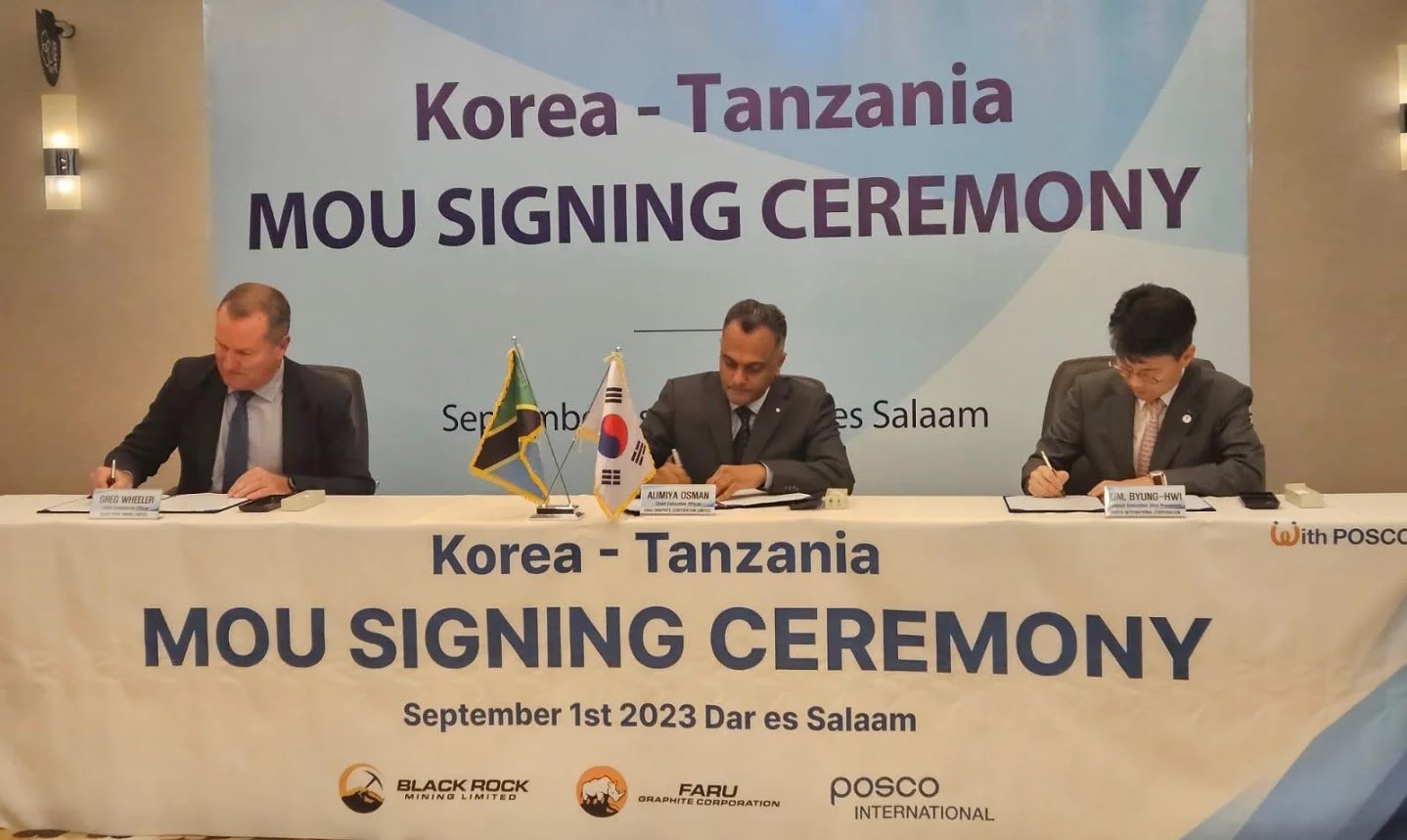
South Korea's Posco International has inked a $40 million investment agreement with Australia’s Black Rock Mining, aiming to double its graphite supply from Tanzania's Mahenge project to 60,000 tonnes per year.

As part of the deal, Posco now holds a 19.9% stake in Black Rock Mining. The investment ensures Posco early access to graphite, a crucial material for its integrated battery supply chain. The Mahenge project is set to begin construction this year, with full-scale production slated for 2026.

Last year, Posco funded the first phase of the mine’s development, securing 30,000 tonnes per year for 25 years. The new Phase 2 contract will supply an additional 30,000 tonnes annually over the same period, bringing the total to 60,000 tonnes per year.

The company plans to use non-Chinese graphite for cathode materials, aligning with the U.S. Inflation Reduction Act and the EU’s Critical Raw Materials Act, which mandate compliant raw material sourcing for electric vehicle (EV) batteries.

As China continues to curb graphite exports, Posco is leveraging reduced EV battery demand to invest in raw material assets with long-term growth potential, such as lithium and graphite.

Additionally, Posco expects to expand its graphite operations globally by securing a sales agreement with Black Rock for industrial graphite used in steel, cement, and automotive components. This could also bolster South Korea’s mineral resource security.

Brazil Mineral Exports Rise as Imports Climb on Fertilizer Feedstock Demand

No comments
Brazil Mineral Exports Rise as Imports Climb on Fertilizer Feedstock Demand
Brazil Mining

Brazil mineral exports increased in the first quarter of 2026, while imports rose more sharply as the country continued to rely on overseas supply for fertilizer-related minerals. National mining institute Ibram reported that mineral exports rose by nearly 1% from a year earlier, while imports increased by 15%.

Brazil mineral exports reached around 87.9mn t in the quarter, with China remaining the main destination. Iron ore accounted for nearly 54% of total shipments, reinforcing its central role in Brazil’s mining trade balance.

Brazil mineral exports continued to support a large sectoral surplus. The mineral trade surplus reached around $9.3bn in the first quarter, up 20% from the same period in 2025, supported by exports of iron ore, gold and copper.

Iron Ore, Gold and Copper Anchor Brazil’s Mining Surplus

Iron ore remained Brazil’s dominant mineral export in the first quarter. This reflects the country’s established role as one of the world’s key suppliers to steelmaking markets, especially China.

Gold and copper also contributed to export value. These metals are strategically important because gold supports financial and industrial demand, while copper is increasingly tied to grids, electrification, construction and manufacturing.

The rise in the mining trade surplus shows that Brazil’s mineral sector remains a strong foreign-exchange earner. Even modest export volume growth can generate a larger surplus when high-value commodities and stronger pricing conditions support trade values.

China’s role remains especially important. Brazilian iron ore exports depend heavily on Chinese steel demand, infrastructure activity and industrial production. Any slowdown in China can therefore affect Brazil’s mining revenue outlook.

Imports Highlight Fertilizer and Industrial Supply Dependence

Brazil imported 10mn t of mineral products in the first quarter. The US was the largest supplier, accounting for 19% of mineral imports, while Colombia and Canada each supplied about 13%.

Potassium, coal and sulphur led import flows. These materials are important for fertilizer supply and industrial activity, showing that Brazil’s mineral strength does not remove its dependence on imported inputs.

Potassium is especially important for Brazil’s agricultural sector. The country is a major global food producer, but fertilizer supply remains exposed to international trade flows and geopolitical risk.

Sulphur imports also matter because sulphur is used to produce sulphuric acid, a critical input for fertilizers, chemical processing and some mining operations. Coal imports continue to support industrial and energy-related demand.

Ibram projects mining sector investment to rise by 12.5% by 2030, reaching $76.9bn. Critical minerals could account for almost 28% of that total, or $21.3bn.

This investment outlook points to a broader shift in Brazil’s mining strategy. Iron ore will remain the export backbone, but copper, nickel, lithium, rare earths, graphite and other critical minerals could gain strategic importance as global supply chains diversify.

The Metalnomist Commentary

Brazil’s first-quarter trade data show a mining sector that remains strong in exports but still dependent on imported fertilizer and industrial inputs. The next opportunity lies in converting critical minerals investment into higher-value production beyond the country’s traditional iron ore base.

EGA Guinea Bauxite Supply Deal Restores Route to UAE Alumina Operations

No comments
EGA Guinea Bauxite Supply Deal Restores Route to UAE Alumina Operations
Bauxite

EGA Guinea bauxite supply has moved closer to normalisation after Emirates Global Aluminium reached an amicable settlement with Guinea over the revocation of its bauxite mining licence. The agreement will allow Guinean producer CBG to resume bauxite shipments to EGA’s operations in the UAE.

EGA Guinea bauxite supply had been disrupted since Guinean customs suspended shipments from EGA subsidiary Guinea Alumina in October 2024. The suspension followed delays in EGA’s plan to build an alumina refinery in Guinea.

EGA Guinea bauxite supply became more uncertain in 2025 when Guinea revoked EGA’s bauxite mining licence and reassigned it to newly created state-owned firm Nimba Mining. GAC continued to seek redress through legal action before the latest settlement.

The agreement includes a lump-sum payment by Guinea to GAC for the transfer of assets to Nimba Mining. It also renews EGA’s bauxite supply agreements with CBG under mutually beneficial commercial terms.

Guinea Settlement Reopens a Strategic Bauxite Channel

The settlement is important because Guinea is one of the world’s most important bauxite supply sources. Its high-volume export role makes it central to alumina refineries and integrated aluminium producers.

For EGA, access to Guinean bauxite supports feedstock security for its Al Taweelah alumina refinery in the UAE. Stable bauxite supply is essential because alumina production depends on consistent ore quality, logistics and long-term commercial arrangements.

The dispute also shows how resource nationalism is reshaping aluminium raw material supply. Guinea has been pushing for more domestic value creation and stronger state control over mining assets.

The revocation of EGA’s licence formed part of a broader review of more than 50 mining licences granted over the past two decades. Those licences covered bauxite, iron ore, gold, diamonds and graphite.

By transferring assets to Nimba Mining while renewing supply through CBG, Guinea preserves more state influence while allowing trade with EGA to resume. This gives both sides a practical route out of a prolonged dispute.

For the wider aluminium market, the settlement reduces one layer of uncertainty around bauxite flows. However, it also reinforces the need for producers to manage political risk in key mining jurisdictions.

Hormuz Disruption and Smelter Damage Still Cloud Recovery

The bauxite agreement does not immediately remove all operational risk for EGA. The resumption of shipments to Al Taweelah depends on the reopening of the Strait of Hormuz, which has been disrupted by the US-Israel and Iran war.

This adds a logistics risk to the feedstock recovery. Even with commercial terms resolved, bauxite and alumina supply chains still depend on safe shipping routes through one of the world’s most strategic maritime chokepoints.

EGA is also dealing with damage at its Al Taweelah aluminium smelter after a missile attack on 28 March. Operations there could take a year to resume, creating a separate challenge for the company’s primary aluminium output.

The situation highlights the dual exposure of integrated aluminium producers. They need secure upstream bauxite and alumina supply, but they also need reliable power, smelter operations and shipping routes.

For EGA, the Guinea settlement is a major positive for raw material continuity. But the company’s near-term recovery will still depend on geopolitical stability, shipping access and the pace of repairs at Al Taweelah.

The broader industrial message is clear. Aluminium supply security now depends on more than ore availability. It requires political settlement, maritime access, energy security and resilient smelting infrastructure.

The Metalnomist Commentary

EGA’s settlement with Guinea shows that bauxite supply is becoming a political asset, not just a mining contract. The deal restores an important feedstock route, but Hormuz disruption and Al Taweelah damage show how fragile integrated aluminium supply chains have become.

Titan Mining Secures EXIM Loan for New York Zinc Expansion

No comments
Titan Mining Secures EXIM Loan for New York Zinc Expansion
Titan Mining

EXIM Financing to Support Zinc Growth

Titan Mining has secured $15.8mn in financing from the Export-Import Bank of the US (EXIM) to expand its zinc operations in New York. The funds will be used by its subsidiary, Empire State Mines, to upgrade equipment and infrastructure. The loan has a seven-year tenor with a two-year interest-only grace period, offering the company time to ramp up production.

Zinc Production and Resource Outlook

Titan expects to produce 64mn–69mn lbs of payable zinc in 2025. The mine’s measured and indicated resources total 636mn lbs of recoverable zinc and 541mn lbs of payable zinc, supporting long-term output. In January, Titan announced plans to extend the mine’s life to 2033. Additionally, the company aims to expand into graphite development alongside its zinc operations, reflecting a broader strategy in critical minerals.

The Metalnomist Commentary

Titan Mining’s EXIM loan demonstrates how US financial institutions are reinforcing domestic critical mineral projects. While zinc demand is rising, the company’s parallel push into graphite shows a strategic pivot toward battery minerals. This dual focus positions Titan to benefit from both traditional and energy transition markets.

Chinalco Guinea Alumina Plant Plan Deepens China’s Bauxite Processing Footprint

No comments
Chinalco Guinea Alumina Plant Plan Deepens China’s Bauxite Processing Footprint
Chinalco

Chinalco Guinea alumina plant plans mark another major step in shifting part of the aluminium value chain closer to Guinea’s bauxite resources. Chinese state-owned aluminium producer Chinalco has signed an agreement with the Guinean government to build a 1.2mn t/yr alumina facility in the country.

Chinalco Guinea alumina plant investment is expected to total $1bn. The company has not released a construction timeline, but said the production line will use local bauxite resources, which should support cost competitiveness.

Chinalco Guinea alumina plant development is strategically important because Guinea is China’s largest bauxite supplier. China imported 149mn t of Guinean bauxite in 2025, up 35% from a year earlier and equal to 74% of its total bauxite imports.

The project shows how Guinea’s resource policy is starting to reshape aluminium supply chains. The country is pushing mining companies to invest in local alumina production instead of exporting only raw bauxite.

Guinea Pushes Bauxite Miners Toward Local Value Addition

Guinea has strengthened mining supervision in recent years as it seeks more economic value from its bauxite reserves. Authorities are requiring large mining companies to build alumina plants in the country.

This policy shift matters because bauxite is only the first stage of the aluminium chain. Alumina refining captures more value, creates industrial jobs and gives the host country a stronger role in downstream processing.

For China, local alumina production in Guinea could reduce pressure on long-distance bauxite logistics. It may also help Chinese aluminium companies secure a more stable feedstock chain in a country that has become essential to their raw material supply.

Guinea’s leverage has increased because Chinese refiners depend heavily on its ore. With nearly three-quarters of China’s bauxite imports coming from Guinea, policy changes in Conakry can directly affect Chinese alumina and aluminium economics.

The $1bn Chinalco project therefore reflects both opportunity and pressure. Chinese firms can keep access to Guinean bauxite, but they increasingly need to commit capital to local processing.

Chinese Alumina Investment Faces Policy and Execution Risk

Chinalco’s agreement follows the start of construction by Inner Mongolia Dian Tou Energy on an alumina plant in Guinea’s Tougnifilidy area in March 2025. That project was described as the first Chinese-owned alumina project in Guinea.

Market participants expect Guinea’s alumina output to rise over the next five years. If these projects advance, Guinea could move from being mainly a bauxite exporter toward becoming a more meaningful alumina producer.

The shift could alter aluminium raw material trade flows. More alumina produced in Guinea may eventually reduce the need to ship some bauxite to China for refining, depending on costs, logistics and power availability.

However, execution risk remains high. Alumina refining requires capital, power, water, infrastructure, environmental management and stable policy terms. Project economics will depend on more than bauxite availability.

Guinea’s military government also moved in May 2025 to rescind mining licences granted over the previous two decades across bauxite, iron ore, gold, diamonds and graphite. That action has increased pressure on mining companies and reinforced the importance of compliance with local value-addition requirements.

For Chinese aluminium producers, the direction is clear. Guinea remains indispensable, but access to bauxite is increasingly tied to local investment, refining commitments and government expectations.

The Metalnomist Commentary

Guinea is using its bauxite dominance to force a deeper industrial bargain with foreign miners. Chinalco’s alumina project shows that China’s aluminium supply chain is no longer only about importing ore; it is becoming tied to processing investment inside resource countries.

Dazhong Mining Expands Lithium Resources at Jiada Mine

No comments
Dazhong Mining Expands Lithium Resources at Jiada Mine
Dazhong Mining

Lithium Resources at Jiada Mine Increase Significantly

Inner Mongolia Dazhong Mining has revised higher its lithium resource estimates at the Jiada spodumene mine in Sichuan. The mine’s reserves now total 1.4842mn t of lithium carbonate equivalent (LCE) with an average grade of 1.38pc lithium oxide. This upgrade raises Dazhong’s total lithium resources across its assets to 4.72mn t LCE. The company also operates the Jijiaoshan lithium mine in Hunan province, strengthening its domestic lithium footprint.

Dazhong’s Investment in Lithium Supply Chain Expansion

Dazhong is actively expanding into downstream lithium processing and battery production. The firm is building lithium carbonate and cathode active material production lines, alongside lithium-ion battery plants in Hunan, with an investment of 16bn yuan ($2.2bn). It also plans to develop a large-scale complex in Inner Mongolia with 40,000 t/yr lithium carbonate, 40,000 t/yr lithium salts, 250,000 t/yr lithium iron phosphate, 100,000 t/yr artificial graphite anode material, and 10 GWh/yr lithium-ion batteries. These projects highlight China’s ambition to dominate the entire lithium value chain.

Lithium Market Pressures Despite Long-Term Demand

The lithium market remains oversupplied, pushing prices to multi-year lows despite robust long-term demand forecasts. Chinese lithium carbonate prices are currently at Yn59,800-61,000/t ex-works, down 89pc from the November 2022 peak of Yn561,000-576,000/t. Rising supply from Chinese producers, including new capacity expansions like Dazhong’s, has weighed on spot prices. However, strong demand from electric vehicles, energy storage systems, and emerging battery technologies is expected to support recovery in the medium term.

The Metalnomist Commentary

Dazhong Mining’s resource upgrade and heavy downstream investments underline China’s strategy to secure leadership across the lithium supply chain. While today’s oversupply keeps prices depressed, structural demand from EVs and storage solutions suggests that projects like Jiada will be vital in balancing the global market in the next decade.

South Star to Launch Graphite Production in Brazil in September

No comments

Canadian battery-metals project developer South Star is set to commence production at its graphite mine in Brazil in September. The company announced today that it has "substantially completed" the first phase of construction at its Santa Cruz graphite mine, located in the northeastern state of Bahia.

The initial phase of the project features a plant with a nameplate capacity of approximately 12,000 metric tonnes per year. The plant is currently in its commissioning phase, and South Star aims to fulfill its first graphite purchase orders in the fourth quarter of this year.

Looking ahead, Santa Cruz's phase 2 expansion is expected to increase production to 25,000 tonnes per year starting in 2026. Phase 3 will further ramp up production to 50,000 tonnes per year by 2028.

Brazil is recognized as the world’s second-largest graphite producer, with over 80 years of continuous mining activity, according to South Star.

US Critical Mineral Processing Funding Targets Domestic Battery Supply Chain

No comments
US Critical Mineral Processing Funding Targets Domestic Battery Supply Chain
Critical Mineral

US critical mineral processing funding is moving into another major round as the Department of Energy prepares to allocate up to $500mn for processing, recycling, and derivative battery manufacturing projects. The funding opportunity is designed to support US-based projects that can strengthen domestic supply of critical minerals and battery materials.

The Department of Energy will target projects that process raw feedstocks, recycle critical materials, or manufacture battery materials and components. The agency specifically identified battery-related materials such as lithium, graphite, nickel, copper, and aluminum among its areas of focus.

US critical mineral processing funding is becoming a central tool in Washington’s effort to reduce dependence on offshore refining and battery material supply chains. The latest funding round also shows that the US is not only focused on mining, but on the midstream capacity needed to convert raw materials into usable industrial inputs.

DOE Funding Pushes Midstream Capacity Beyond Mining

Critical mineral processing remains one of the most difficult gaps in the US battery supply chain. Mining projects can expand raw material availability, but domestic industrial resilience depends on refining, chemical conversion, recycling, and component manufacturing.

The new funding opportunity will support projects that can process critical minerals from raw feedstocks and recycle valuable materials back into the supply chain. This approach reflects the growing importance of black mass, scrap, and secondary materials as strategic inputs for battery production.

DOE battery materials funding also gives policy support to companies working across lithium chemicals, graphite processing, nickel products, copper materials, aluminum inputs, and battery component manufacturing. These segments are essential for electric vehicles, grid storage, defense electrification, and industrial energy systems.

Battery Manufacturing Policy Enters Third Funding Round

The latest funding notice marks the third round in recent years under the DOE’s battery materials processing and battery manufacturing and recycling programs. In September 2024, the agency selected 25 projects to receive more than $3bn to expand domestic battery, component, and critical material supply.

The new $500mn opportunity extends that policy direction. It gives the US another mechanism to move from strategic mineral rhetoric toward physical processing capacity, especially in areas where China still dominates global refining and battery material production.

Applicants must submit non-binding letters of intent by 27 March, with full applications due by 24 April. The timeline signals that the DOE wants near-term project visibility and a faster pipeline of investable domestic capacity.

US critical mineral processing funding will be especially important for companies that can prove commercial readiness, feedstock security, and scalable production. The strongest projects will likely be those that connect raw material access with downstream battery customers and recycling loops.

The Metalnomist Commentary

The US is now treating processing capacity as the real bottleneck in critical minerals security. Funding can accelerate projects, but the strategic test will be whether supported companies can deliver cost-competitive, qualified material at industrial scale.

Brazil Critical Minerals Bill Moves Country Toward Domestic Processing Strategy

No comments
Brazil Critical Minerals Bill Moves Country Toward Domestic Processing Strategy
Critical Minerals

Brazil critical minerals bill approval by the lower house marks a major step toward turning the country’s mineral reserves into a domestic industrial development strategy. The bill establishes the national policy of critical and strategic minerals and creates incentives for companies to process and transform those materials inside Brazil.

Brazil critical minerals bill measures include a new mineral activity guarantee fund backed by R2bn in federal money. The fund will support projects linked to the production of critical and strategic minerals.

Brazil critical minerals bill incentives also include R5bn in tax credits over five years to encourage processing and transformation. This shows that Brazil does not want to remain only an exporter of raw materials.

The bill will now move to the senate. Mines and energy minister Alexandre Silveira said he will work directly with senators to accelerate approval, framing critical minerals as a matter of economic modernisation and national sovereignty.

Processing Incentives Target Value Creation Inside Brazil

The bill creates the national council for the industrialisation of critical and strategic minerals. The council will decide which minerals qualify as critical and strategic and will update the list every four years.

This structure is important because Brazil has large resource potential but still needs stronger domestic processing capacity. Without refining, separation, transformation and recycling, mineral wealth can leave the country as low-value raw material.

The proposed guarantee fund and tax credits are designed to change that pattern. They will support projects considered strategic under the national policy, with a focus on minerals that can strengthen Brazil’s industrial base.

Congress member Arnaldo Jardim, the bill’s rapporteur, said critical minerals represent a development opportunity for Brazil. He argued that the country should become a major rare earths producer, stimulate recycling through urban mining and make its processing industry more competitive.

That message reflects a broader shift in resource policy. Brazil is trying to position critical minerals as a tool for industrial development, not only export revenue.

Rare earths are especially important. Brazil has significant rare earth potential, and global buyers are searching for alternatives to China-dominated supply chains. If Brazil can move beyond mining into separation and processing, it could become more relevant to magnet, defence, electronics and clean energy markets.

Urban mining also deserves attention. Recycling can strengthen domestic supply, reduce waste and create secondary sources of critical materials from electronics, batteries, industrial scrap and end-of-life equipment.

US Interest Raises Brazil’s Strategic Importance

The bill comes as Brazil and the US are discussing critical minerals more actively. Presidents Luiz Inacio Lula da Silva and Donald Trump are expected to meet this week, and critical minerals are likely to be part of the agenda.

The US has long sought a critical minerals agreement with Brazil. Goias state has already signed a cooperation agreement with the US, although Brazil’s federal government has challenged its legal validity.

That dispute shows how politically sensitive critical minerals have become. Foreign partnerships can bring investment and market access, but the federal government wants to ensure that strategic minerals serve national interests.

Brazil holds about 10% of global critical minerals reserves, according to domestic research and mining institutions. The sector is expected to attract $21.3bn in investment by 2030.

This gives Brazil strong leverage. The country has rare earths, niobium, graphite, nickel, lithium and other minerals that are increasingly important to batteries, magnets, aerospace, electronics and energy transition technologies.

However, reserves alone will not determine Brazil’s role. The country must build processing capacity, permitting efficiency, infrastructure, financing tools and reliable industrial partnerships.

The new policy could help unlock that pathway. If approved by the senate and implemented effectively, it could shift Brazil from a raw material supplier toward a more integrated critical minerals economy.

The Metalnomist Commentary

Brazil is making the right strategic move by linking critical minerals to processing, tax incentives and industrial policy. The real test will be execution: Brazil must convert resource potential into refining, separation, recycling and customer-ready supply before global competitors secure the next wave of investment.

India Critical Minerals Auctions Expand Supply Push for Clean Energy Manufacturing

No comments
India Critical Minerals Auctions Expand Supply Push for Clean Energy Manufacturing
India, auction for critical minerals.jpg

India critical minerals auctions have entered a new phase as the government launched the seventh tranche of critical and strategic mineral block auctions. The Ministry of Mines is offering 19 blocks under mining lease and composite licence across several states.

The latest India critical minerals auctions cover minerals needed for clean-energy manufacturing, advanced technologies, fertilisers, and strategic industries. The move reflects New Delhi’s effort to reduce import dependence and build domestic supply chains for high-value minerals.

India critical minerals auctions have become a central tool in the country’s resource security strategy since the August 2023 amendment to the Mines and Minerals Act. That reform classified 24 minerals as critical and strategic and gave the central government authority to auction them.

Regulatory Reforms Aim to Speed Up Mineral Development

India is tightening its auction framework to improve project execution after bidding. The Mineral Auction Second Amendment Rules, 2025, are designed to streamline post-auction procedures and reduce delays between award and development.

The 2026 rules also introduce insurance surety bonds as an alternative to bank guarantees. This could ease financial pressure on bidders and support broader participation from mining companies, technology firms, and downstream industrial players.

Auction revenues will go to the respective state governments, creating a stronger link between central mineral policy and state-level resource development. This structure could help states support permitting, infrastructure, and local industrial ecosystems around critical mineral projects.

Lithium, Graphite and Rare Earths Drive Industrial Strategy

The Ministry of Mines has already launched six tranches and auctioned 46 blocks. Industry participation has strengthened as demand rises for lithium, graphite, rare earth elements, tungsten, vanadium, titanium, and other rare metals.

These minerals are becoming essential for batteries, electric vehicles, renewable energy systems, aerospace, electronics, specialty alloys, fertilisers, and defense-related applications. India’s challenge is not only discovering resources, but also building processing, refining, and manufacturing capacity around them.

The seventh tranche therefore fits into a broader industrial policy agenda. India wants to position itself as a manufacturing hub while securing the mineral inputs needed for energy transition technologies and strategic supply chains.

The Metalnomist Commentary

India’s auction program shows that critical mineral security is becoming a state-backed industrial race. The real test will come after auction awards, when India must convert mineral blocks into mines, processing capacity, and downstream manufacturing strength.

Brazil Allocates R5bn to Boost Critical Minerals Development

No comments
Brazil Allocates R5bn to Boost Critical Minerals Development
Bndes

Funding Expands Rare Earths, Lithium, and Graphite Projects

Brazil has awarded R5bn ($908mn) to support 56 critical mineral and research projects, signaling stronger investment in strategic resources. The funding, provided by the state development bank BNDES and federal agency Finep, will support mining and innovation initiatives tied to the energy transition.

Over 30% of the funds are directed toward rare earths and lithium, while graphite, copper, and silicon also feature prominently. The selection process included 53 companies, with major recipients such as Stellantis and Weg advancing energy and mobility-related projects.

High Demand Outpaces Available Financing

Brazil received requests for R45.8bn ($8.2bn), but only a fraction was financed. This underscores the strong demand for critical mineral project funding, with only R5bn allocated in the initial round. Applicants now must decide by 25 July whether to pursue loans, equity, grants, or subsidies.

Projects targeting platinum group metals, nickel, niobium, and titanium also received backing, highlighting Brazil’s broad resource base. The program prioritizes projects with research and development plans that support decarbonization and clean energy technologies.

Brazil’s Strategic Position in Global Supply Chains

Brazil holds leading reserves of niobium, graphite, nickel, rare earths, silicon, and lithium. This positions the country as a critical supplier in global energy transition supply chains. According to BNDES, Brazil is the world’s top niobium producer and ranks among the top five globally for several other strategic minerals.

The allocation of funds aims to accelerate local processing, innovation, and integration into global supply chains. As energy security and geopolitical pressures reshape markets, Brazil’s role in critical minerals is likely to grow in importance.

The Metalnomist Commentary

Brazil’s R5bn critical minerals funding demonstrates strategic prioritization of resources essential to the energy transition. While financing demand far exceeded available capital, the program highlights Brazil’s ambition to move beyond raw exports toward innovation-driven value chains. Long-term success will hinge on ensuring that projects deliver both economic returns and sustainability outcomes.

Brazil Critical Minerals Fund Attracts $85 Billion in Proposals

No comments
Brazil Critical Minerals Fund Attracts $85 Billion in Proposals
Brazil Critical Minerals

High investor interest spans lithium, rare earths, copper, and graphite across 23 Brazilian states

$5B fund aims to drive energy transition and scale-up Brazil’s strategic minerals
The new Brazil critical minerals fund, valued at $5 billion, has sparked major investment interest, receiving 124 proposals totaling over $85 billion. Launched amid rising global trade barriers and U.S. tariffs on critical minerals, the fund is designed to boost Brazil’s domestic mining, R&D, and downstream innovation.

Lithium and rare earths lead proposal volume across a wide mineral spectrum

Proposals submitted between 7 January and 30 April came from across 23 of Brazil’s 26 states and cover over 40 different minerals. Notably, the fund received 27 proposals for rare earths, 25 for lithium, 24 for copper, and 20 for graphite. Each submission required a detailed plan for research, development, and industrial innovation to support energy transition and decarbonization goals.

The Brazil critical minerals fund encourages local transformation of raw materials into energy-related products. This initiative could significantly expand Brazil’s role in the global critical mineral supply chain, especially in the face of U.S.-China resource tensions and shifting ESG standards.

Brazil positions itself as a global mineral powerhouse

BNDES, the state development bank administering the program with FINEP, highlights Brazil’s global resource base: the world’s largest niobium reserves and production, second-largest natural graphite reserves, and top-five positions in lithium, nickel, rare earths, and silicon. Eligible minerals for funding include aluminum, cobalt, manganese, molybdenum, titanium, tungsten, and uranium, among others.

Approved projects will receive tailored financial support—including loans, equity investments, grants, and subsidies—based on a two-stage evaluation. Although only a portion of proposals will be funded, the scale of demand underscores the region’s potential as a critical mineral hub.

The Metalnomist Commentary

The Brazil critical minerals fund reflects Latin America’s growing assertiveness in global supply chains. As Western countries scramble for non-Chinese resources, Brazil’s broad resource portfolio and downstream ambitions make it a pivotal player in the energy transition economy.