Showing posts sorted by date for query Tanzania’s. Sort by relevance Show all posts

Burundi–Tanzania Mineral Railway to Unlock East African Nickel Exports

No comments
Burundi–Tanzania Mineral Railway to Unlock East African Nickel Exports
Burundi Mineral

The Burundi–Tanzania mineral railway will create a direct, electrified export route for nickel. The plan covers a 650km standard-gauge line to 2030. The Burundi–Tanzania mineral railway targets 3mn t/yr of nickel throughput. The African Development Bank backs the $2.15bn project. The Burundi–Tanzania mineral railway will connect Musongati to Uvinza and onward to Dar es Salaam. China Railway Engineering will support construction and technology transfer.

Route design, capacity, and schedule

The railway links Musongati’s deposits to Tanzania’s Uvinza junction. Trains will reach Dar es Salaam port within 12 hours. This halves the current transit time of roughly 25 hours. The line will use full electrification for efficiency and emissions. Designers set capacity at 3mn t/yr for nickel concentrate. The schedule targets completion around 2030, pending milestones. Standard-gauge specs enable higher axle loads and speeds.

Strategic impact on nickel and regional minerals

Burundi holds about 6% of global nickel deposits. Therefore, scalable logistics can unlock mine financing. The corridor also supports lithium, tin, gold, and copper. Potential extensions reach Kindu in the DRC and West Africa. This builds a pan-African minerals trade spine. Government partners will finalize resources and licensing work. Validation will de-risk engineering and commercial studies.

The Metalnomist Commentary

This railway shifts East African nickel from concept to credible export pathway. Execution risk sits in funding tranches, power reliability, and port interfaces. Watch EPC progress and anchor offtakes that de-risk commissioning.

Ntaka Hill Nickel and Copper Project Advances with Ningbo–STAMICO Partnership

No comments
Ntaka Hill Nickel and Copper Project Advances with Ningbo–STAMICO Partnership
Ningbo Stamico

The Ntaka Hill nickel and copper project is moving forward after years of dispute. A new processing plant is planned before end-2025. The Ntaka Hill nickel and copper project will use Chinese technologies to optimize output. Indiana’s 2024 settlement cleared the path for development. Therefore, the Ntaka Hill nickel and copper project regains momentum in Tanzania’s battery metals landscape.

Project restart, licenses, and near-term milestones

STAMICO and Ningbo Shuangbeng signed a tentative agreement on 10 August. As a result, they will revive the stalled Ntaka Hill assets. STAMICO will complete geological assessments and resource evaluations. It will validate existing drilling and update resource estimates. Meanwhile, it will seek a license for an unexplored section. These steps underpin financing, plant design, and permitting.

Processing plant plan, funding, and technology transfer

Coast Nickel targets plant commissioning before end-2025. The facility will process ore from the Ntaka Hill site. Ningbo Shuangbeng stands ready to fund and supply technology. However, construction depends on rapid geological verification. The approach aims to shorten time to first product. Consequently, Tanzania strengthens its nickel and copper value chain.

The Metalnomist Commentary

A credible restart hinges on verified resources, EPC discipline, and power access. If milestones hold, Ntaka Hill could rejoin Africa’s emerging battery metals hubs. Watch the verification timeline and offtake traction through 2025.

Tanzania Opens First Copper Processing Plant to Boost Exports

No comments
Tanzania Opens First Copper Processing Plant to Boost Exports
Tanzania Copper Mining

Tanzania has officially launched its first copper processing plant, signaling its ambition to become a major African copper exporter. The new facility, located in Chunya district, Mbeya region, was inaugurated by Prime Minister Kassim Majaliwa and is operated by Mineral Access Systems Tanzania (Mast).

Tanzania’s Strategic Move into Copper Processing

The copper processing plant is a milestone in Tanzania’s industrial development, moving the nation away from exporting raw minerals. The facility will process low-grade copper ore containing 0.5–2pc copper into concentrate with up to 75pc purity using leaching and cementation technology. The plant’s capacity is 31,200 t/month, with 27,200t supplied from Mast’s own mine and 4,000t sourced from small-scale miners.

Expanding Domestic Copper Potential

Mast has announced plans to build three more processing plants in Manyara, Ruvuma, and Dodoma, strengthening the country’s copper production capacity. While Tanzania has traditionally focused on gold mining, rising copper prices and global demand are shifting priorities toward copper as a strategic resource. International companies are also entering the market, including Resource Mining, which has acquired copper-gold projects in Mpanda and Mbozi.

The Metalnomist Commentary

Tanzania’s new copper processing facility highlights its determination to diversify beyond gold and capture value from rising copper demand. By investing in midstream capacity and encouraging small-scale miners, the country strengthens its position in Africa’s copper supply chain. Long-term success will depend on sustaining investment and ensuring reliable infrastructure.

Shenghe Resources Acquires 100% Stake in Peak Rare Earth for Overseas Expansion

No comments
Shenghe Resources Acquires 100% Stake in Peak Rare Earth for Overseas Expansion
Peak Rare Earth

Shenghe Resources completed a strategic Shenghe Peak Rare Earth acquisition worth A$158 million ($729.86 million) to secure complete ownership of the Australian mining company and its Tanzanian assets. The Chinese rare earth producer's subsidiary Ganzhou Chenguang executed the purchase to accelerate overseas rare earth resource development beyond China's domestic market. This Shenghe Peak Rare Earth acquisition builds upon Shenghe's existing 19.9% shareholding established in early 2022 and strengthens China's global rare earth supply chain control.

Ngualla Project Anchors Tanzania Rare Earth Strategy

The Ngualla project represents the centerpiece of the Shenghe Peak Rare Earth acquisition, featuring 4.61 million tonnes of rare earth oxide (REO) resources and 887,000 tonnes of REO reserves. Peak Rare Earth holds an 84% stake in the Tanzanian project, with the government retaining the remaining ownership share. Meanwhile, the project maintains an impressive average grade of 4.8% and praseodymium-neodymium oxide content of 21.26%.

Construction completion and operational startup are scheduled for early 2026, with initial production targeting 18,000 tonnes REO of rare earth concentrate annually. This output will yield approximately 4,000 tonnes of praseodymium-neodymium oxide, critical materials for permanent magnet manufacturing. Therefore, the Ngualla project will significantly boost Shenghe's production capacity for high-value magnetic rare earth elements.

Heavy Mineral Sands Portfolio Expands Through Strategic Acquisitions

Shenghe diversified its Tanzanian operations through the Fungoni project, which commenced heavy mineral sands production in late 2024. The first production line achieved operational status, with additional lines expected online before September to reach 100,000 tonnes per year total capacity. As a result, Shenghe secured both rare earth and heavy mineral sands resources within Tanzania's mineral-rich regions.

The company acquired complete ownership of Strandline Resources UK Limited (SRUL) in May 2024, gaining control of the Fungoni project's operating subsidiary Tanzanian Nyati Mineral Sands. Furthermore, Shenghe purchased a 65% stake in Jiacheng Mining (Shanghai) and 100% of African Resources Company, adding 27 million tonnes of heavy mineral sands resources. However, these acquisitions require integration with existing operations to maximize synergies across the portfolio.

Shenghe's financial performance reflected these strategic investments, with revenues reaching 2.99 billion yuan ($415 million) in the first quarter, representing 3.66% year-over-year growth. Net profit surged to 168.22 million yuan from a previous year loss of 215.57 million yuan. Consequently, rising rare earth prices, tighter spot supplies, and increased sales volumes drove this remarkable financial turnaround for the expanding company.

The Metalnomist Commentary

Shenghe's aggressive overseas acquisition strategy demonstrates China's determination to secure critical rare earth supply chains beyond domestic borders, particularly in Africa's mineral-rich regions. The Peak Rare Earth acquisition provides strategic access to high-grade praseodymium-neodymium resources essential for permanent magnet production, while the Tanzanian portfolio diversification reduces supply concentration risks through geographic and commodity expansion.

Marula Mining Advances Kinusi Copper Project in Tanzania

No comments
Marula Mining

Phase 1 Commissioning Nears Completion, Boosts Initial Copper Sales
London-based Marula Mining is nearing the completion of the first phase of its Kinusi copper mine in Tanzania's central Dodoma region. The company announced it is close to finalizing initial copper sales and commissioning phase 1 of the project.

Escalating Mining Efforts and Delayed Sales

Marula is developing a substantial open pit mine that includes a two-phase processing operation. The intensification of mining activities this quarter is pivotal for the commissioning of phase 1. This initial phase is projected to produce 24,000 tons per year of high-grade copper concentrate. Meanwhile, phase 2 is set to initially produce 10,200 tons per year of copper cathode.

Due to extended timelines required for metal testing, Marula has postponed the completion of its initial sales, which include 1,000 tons of copper, to January 31. These tests, crucial for finalizing sales agreements and refining the design of the processing plants for both phases, have reportedly exceeded expectations.

Marula Mining Unveils Updated Development Plans for Tanzania’s Kinusi Copper Mine

No comments
Kinusi Copper

Marula Mining, a London-listed company, revealed an updated development plan on September 26 for its Kinusi copper mine, located in Tanzania's Dodoma Region. According to the updated strategy, the company aims to establish a large-scale open-pit mining operation accompanied by a two-phase processing plan.

Phase 1 of the project is expected to yield approximately 24,000 tons per year (t/yr) of high-grade copper concentrate, while Phase 2 will produce an initial 10,200 t/yr of copper cathode. The first phase of the project is currently undergoing final test work, which is anticipated to be completed in South Africa by the fourth quarter of this year. Initial mining activities will begin in the same timeframe.

Timeline and Production Targets

The production of high-grade copper concentrate from Phase 1 is slated to commence in the first quarter of 2025, with the company aiming to achieve its first export sales by the end of the same quarter. This strategic plan positions Marula Mining as a significant player in Tanzania’s copper mining industry, contributing to the global copper supply chain.

Posco Invests $40 Million in Black Rock's Tanzanian Graphite Project

No comments

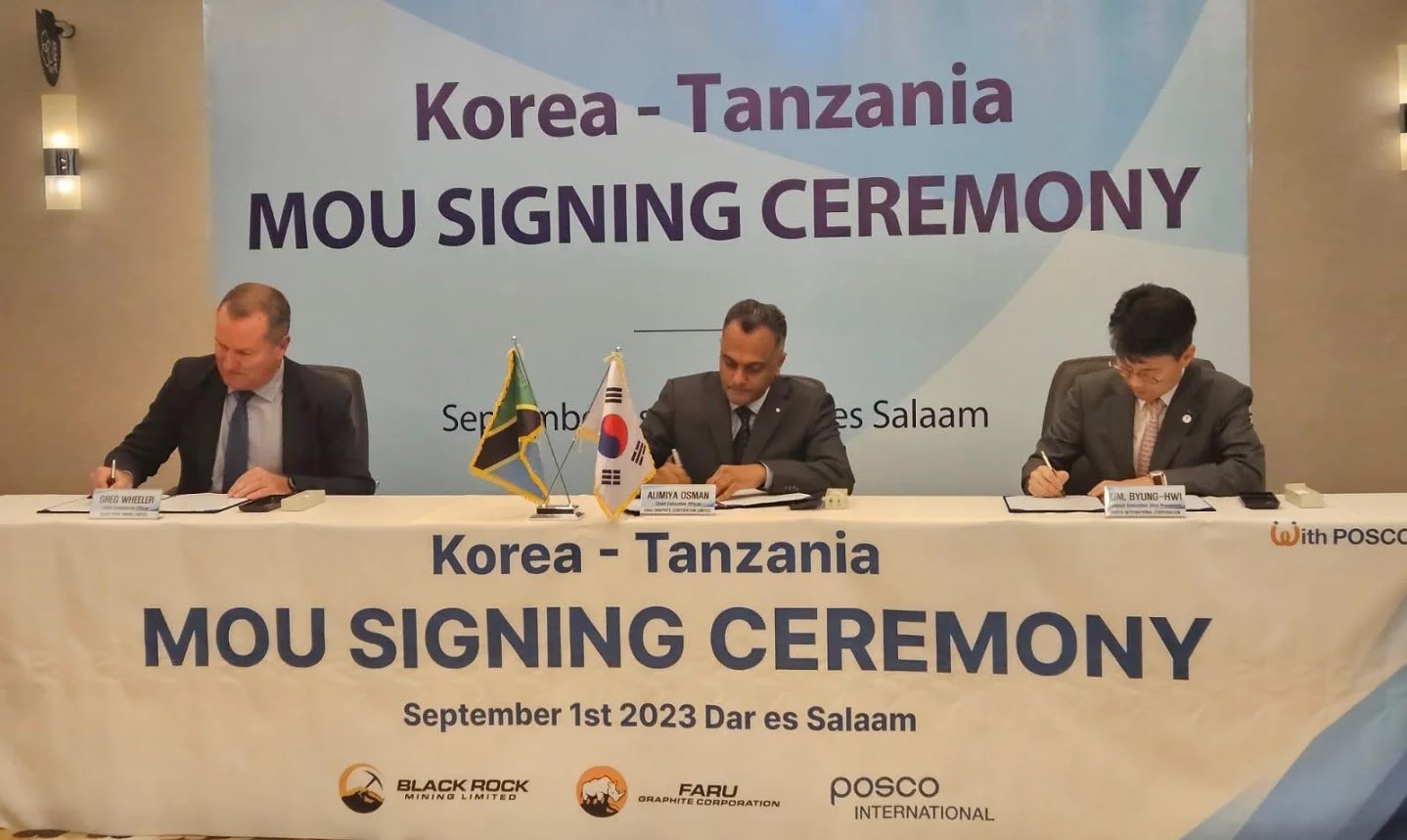
South Korea's Posco International has inked a $40 million investment agreement with Australia’s Black Rock Mining, aiming to double its graphite supply from Tanzania's Mahenge project to 60,000 tonnes per year.

As part of the deal, Posco now holds a 19.9% stake in Black Rock Mining. The investment ensures Posco early access to graphite, a crucial material for its integrated battery supply chain. The Mahenge project is set to begin construction this year, with full-scale production slated for 2026.

Last year, Posco funded the first phase of the mine’s development, securing 30,000 tonnes per year for 25 years. The new Phase 2 contract will supply an additional 30,000 tonnes annually over the same period, bringing the total to 60,000 tonnes per year.

The company plans to use non-Chinese graphite for cathode materials, aligning with the U.S. Inflation Reduction Act and the EU’s Critical Raw Materials Act, which mandate compliant raw material sourcing for electric vehicle (EV) batteries.

As China continues to curb graphite exports, Posco is leveraging reduced EV battery demand to invest in raw material assets with long-term growth potential, such as lithium and graphite.

Additionally, Posco expects to expand its graphite operations globally by securing a sales agreement with Black Rock for industrial graphite used in steel, cement, and automotive components. This could also bolster South Korea’s mineral resource security.