Showing posts sorted by relevance for query Posco International. Sort by date Show all posts

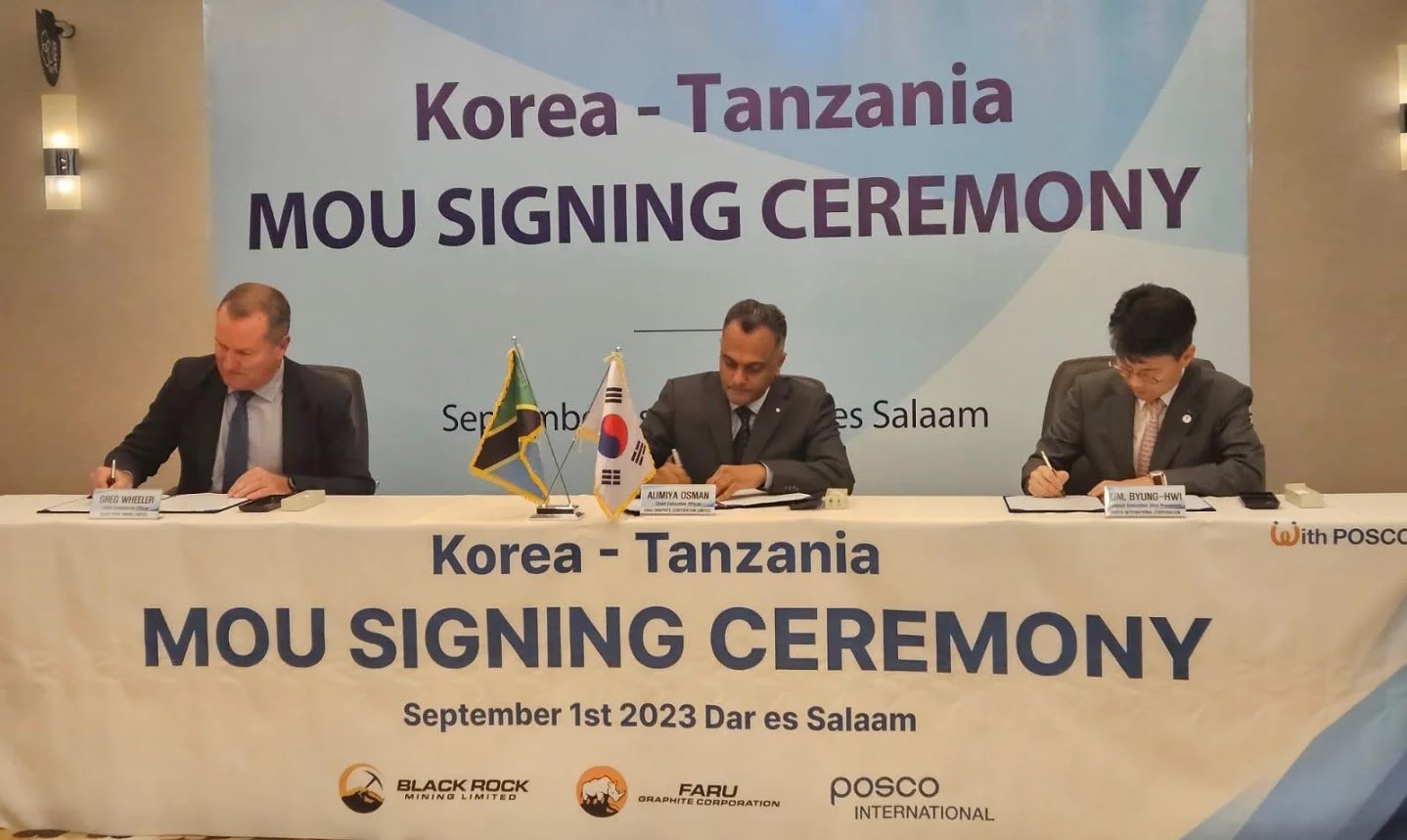
Posco Invests $40 Million in Black Rock's Tanzanian Graphite Project

No comments

South Korea's Posco International has inked a $40 million investment agreement with Australia’s Black Rock Mining, aiming to double its graphite supply from Tanzania's Mahenge project to 60,000 tonnes per year.

As part of the deal, Posco now holds a 19.9% stake in Black Rock Mining. The investment ensures Posco early access to graphite, a crucial material for its integrated battery supply chain. The Mahenge project is set to begin construction this year, with full-scale production slated for 2026.

Last year, Posco funded the first phase of the mine’s development, securing 30,000 tonnes per year for 25 years. The new Phase 2 contract will supply an additional 30,000 tonnes annually over the same period, bringing the total to 60,000 tonnes per year.

The company plans to use non-Chinese graphite for cathode materials, aligning with the U.S. Inflation Reduction Act and the EU’s Critical Raw Materials Act, which mandate compliant raw material sourcing for electric vehicle (EV) batteries.

As China continues to curb graphite exports, Posco is leveraging reduced EV battery demand to invest in raw material assets with long-term growth potential, such as lithium and graphite.

Additionally, Posco expects to expand its graphite operations globally by securing a sales agreement with Black Rock for industrial graphite used in steel, cement, and automotive components. This could also bolster South Korea’s mineral resource security.

Posco and Hancock Prospecting to Construct New Lithium Plant

No comments
Hancock Prospecting

In an ambitious move to secure a more robust lithium supply chain, South Korean steelmaker Posco, in partnership with Australia’s Hancock Prospecting, has announced plans to build a 30,000 metric tonne per year lithium processing plant. The exact location of the plant is still under deliberation, with potential sites being evaluated in various countries, including South Korea.

Strategic Expansion in Lithium Sector

The collaboration between Posco and Hancock is a strategic step to bypass US Foreign Entity of Concern (FEoC) regulations and solidify Posco's standing in the lithium value chain. Posco’s plan is to manage a full spectrum from mining and extraction from salt lakes to producing lithium hydroxide and cathode materials, and eventually recycling them. This comprehensive approach aims to fortify its supply chain amidst growing demand for lithium, primarily driven by the electric vehicle and renewable energy sectors.

Global Partnerships and Investments

Both Posco and Hancock are not new to the lithium industry. Hancock holds a 19.9% stake in Liontown Resources, an Australian lithium developer. Posco has been extending its reach in the lithium market through various international partnerships, including joint ventures with Pilbara Minerals in Australia and an investment in the Sal de Ora brine project in Argentina’s Salar del Hombre Muerto.

These ventures underline both companies' commitment to strengthening their positions within the global lithium market, which is expected to grow significantly due to the increasing emphasis on sustainable and renewable energy resources.

Energy Fuels and Posco Forge Rare Earth Partnership for EV Supply Chain

No comments
Energy Fuels

Deal Could Power Over 30,000 EVs and Reduce Dependence on Chinese Rare Earths

U.S.-Korea Pact Targets EV Magnet Materials

U.S. rare earths producer Energy Fuels has entered a strategic agreement with South Korea’s Posco International to supply neodymium-praseodymium (NdPr) oxide. The material is essential for permanent magnets used in electric vehicle (EV) and hybrid electric vehicle (HEV) drivetrains.

Energy Fuels recently shipped NdPr samples to Posco, which will test them for use in magnet alloy and metal manufacturing. These magnets will be integrated into traction motor cores supplied to automakers across the U.S., Europe, South Korea, and Japan.

Pending successful validation, Energy Fuels and Posco intend to sign a commercial supply agreement. This deal would cover enough NdPr to support magnets for over 30,000 EVs annually, potentially expanding into a longer-term production partnership.

Rare Earth Diversification Strategy Gains Momentum

The collaboration marks a step forward in diversifying the global rare earth supply chain, which remains heavily dominated by China. According to the U.S. Geological Survey, China produced 69%—around 270,000 metric tonnes—of global rare earth ore in 2024.

Energy Fuels aims to challenge that dominance by expanding its rare earth production capacity. The company operates its White Mesa Mill in Utah, producing oxides from monazite concentrates sourced as a by-product of heavy mineral sands.

The company currently has a capacity of 1,000 t/yr for NdPr oxide and plans to scale this up to between 4,000–6,000 t/yr. Future expansions will also include additional rare earth elements such as dysprosium and terbium, which are crucial for high-temperature magnet performance in EVs.

Argentina Salta Lithium Boom Positions Province as Global Energy Transition Hub

No comments
Argentina Salta Lithium Boom Positions Province as Global Energy Transition Hub
Argentina Salta Lithium

Argentina Salta lithium boom accelerates as the northern province emerges as the cornerstone of the country's expanding mining industry following government approval of Rio Tinto's Rincon project under the RIGI incentive program. The Argentina Salta lithium boom reflects strategic positioning within global energy transition supply chains, with provincial mining secretary Romina Sassarini declaring Salta will become "a reference point for lithium in the country and worldwide" as multiple international producers establish operations in the resource-rich region.

RIGI Program Attracts International Lithium Investment

Argentina Salta lithium boom benefits from the national government's RIGI economic and legal incentive program that provides fiscal and legal stability for major mining investments. Rio Tinto's newly approved Rincon mine represents the fourth lithium project in Salta, requiring $2.7 billion investment to produce 60,000 tonnes annually by decade's end. China's Ganfeng, France's Eramine, and South Korea's Posco already operate lithium production facilities while applying for RIGI incentives for expanded production stages.

Meanwhile, Argentina's lithium output surged from 75,000 tonnes in 2024 to projected 131,000 tonnes in 2025 according to mining trade organization CAEM. This rapid production growth positions Argentina as a critical supplier for global battery markets while establishing Salta as the primary production hub. The province's strategic importance extends beyond lithium to include copper and gold reserves, including First Quantum Minerals' $3.5 billion Taca Taca copper-gold-molybdenum project awaiting final permits.

Infrastructure Development Addresses Production Bottlenecks

However, massive infrastructure investments are required to support expanding mining operations and projected production growth. Mining projects operating and planned in Salta require additional 575MW of electricity generation capacity, prompting provincial development of comprehensive electricity plans emphasizing solar power deployment. The renewable energy focus aligns with sustainable mining practices while addressing power supply constraints.

Therefore, transportation infrastructure development becomes equally critical as the province pursues multilateral bank financing for the 2,400-kilometer bi-oceanic highway connecting Brazil to Chile through Argentina and Paraguay. This continental corridor will enable efficient lithium and mineral exports to Pacific and Atlantic markets while reducing logistics costs. Sassarini emphasized that coordinated efforts between provincial, company, and national government stakeholders will resolve logistic bottlenecks limiting industry growth.


Argentina Salta

Strategic Positioning Supports Global Supply Chain Integration

Furthermore, Salta's emergence as a world-class lithium exporter addresses growing global demand for battery materials essential to electric vehicle production and energy storage systems. The province's integrated approach combining multiple international producers, infrastructure development, and regulatory stability creates competitive advantages for sustained industry growth. Mining sector transformation generates substantial economic impact through employment, tax revenue, and supply chain development.

As a result, the RIGI program eliminates financial bottlenecks while creating frameworks for long-term industry development across multiple mineral commodities. Salta's strategic positioning within the Lithium Triangle region enhances Argentina's competitiveness against Chilean and Bolivian producers while serving diverse global markets. The coordinated development approach demonstrates how provincial governments can catalyze mining industry growth through targeted policy support and infrastructure investment.

The Metalnomist Commentary

Argentina's Salta province exemplifies how strategic resource endowments combined with supportive policy frameworks can rapidly transform regional economies into global supply chain hubs, particularly important as lithium demand accelerates through energy transition requirements. The province's comprehensive approach addressing both production capacity and infrastructure bottlenecks demonstrates sophisticated understanding of mining industry development requirements, positioning Salta advantageously within the competitive global lithium market as established and emerging producers seek reliable supply sources.

Lynas Noveon rare earth magnet deal boosts US supply security

No comments
Lynas Noveon rare earth magnet deal boosts US supply security
Lynas

The Lynas Noveon rare earth magnet deal aims to build a resilient US magnet supply chain. The partnership links a major Australian rare earths producer with a US downstream magnet maker at a time of intensifying geopolitical pressure around critical minerals. By structuring the Lynas Noveon rare earth magnet deal around both light and heavy rare earth supply, the companies target segments most exposed to Chinese dominance.

The agreement remains non-binding but already sets a strategic framework for cooperation. It covers rare earth feedstock supply, joint development of production plants and coordinated sales of finished magnets to US end-users. As a result, the Lynas Noveon rare earth magnet deal positions both parties to tap growing demand from electric vehicles, wind turbines, defence platforms and advanced electronics. Crucially, they also plan to work with US policymakers to ensure the emerging supply chain qualifies under national-interest and security frameworks.

US rare earth magnet deal builds on Texas processing investments

Lynas already plays a central role in US rare earth industrial policy. The company is building a Texas facility capable of processing 2,500-3,000 t/yr of heavy rare earths and 5,000 t/yr of light rare earths with US government backing. This plant will provide the upstream foundation needed for the Lynas Noveon rare earth magnet deal, anchoring critical materials processing on US soil rather than in China or Southeast Asia.

Meanwhile, Noveon brings established magnet design and production capabilities, plus direct relationships with US industrial and defence customers. Together, the companies can shorten the distance from mine to magnet, increasing traceability and compliance with US sourcing rules. However, real impact will depend on how quickly the Texas plant ramps up and how fast Noveon can translate material flows into scalable magnet production capacity.

Part of a wider US rare earths and magnet realignment

This agreement comes amid a wave of US-linked rare earth and magnet deals. ReElement Technologies recently partnered with South Korea’s Posco International to develop an integrated rare earth and magnet plant. USA Rare Earth also agreed to acquire UK-based Less Common Metals to support a proposed 5,000 t/yr magnet facility in Oklahoma. These moves, together with the Lynas Noveon rare earth magnet deal, form a multi-node ecosystem designed to reduce US dependence on Chinese rare earth supply chains.

However, building a fully competitive mine-to-magnet value chain in North America will take time. Investment needs remain high, permitting timelines are uncertain, and Chinese producers still enjoy scale advantages and deep customer relationships. As a result, near-term pricing power and market share will likely stay concentrated in Asia, even as Western projects gradually add redundancy and optionality. For end-users, the key benefit in the medium term may be greater diversification rather than immediate cost reductions.

The Metalnomist Commentary

This deal underlines how rare earth strategy is shifting from isolated projects to networked partnerships spanning feedstock, processing and magnets. If Lynas and Noveon can execute on scale and cost, their alliance will become a cornerstone of a genuine US-aligned rare earth industrial base. For now, the real test lies in synchronising project delivery with rapidly evolving policy incentives and downstream demand.

Chile Rio Tinto Lithium Deposit Partnership Secures Largest Undeveloped Resource

No comments
Chile Rio Tinto Lithium Deposit Partnership Secures Largest Undeveloped Resource
Chile Rio Tinto

Chile Rio Tinto lithium deposit partnership emerged as Chile's national mining company Enami selected the Anglo-Australian miner to explore and develop the Altoandinos project, the country's largest undeveloped lithium deposit. The Chile Rio Tinto lithium deposit agreement establishes a public-private concession with Rio Tinto holding 51% ownership while Enami retains 49%, representing a combined $3 billion investment where Rio Tinto contributes $425 million for access to over 15 million tonnes of lithium carbonate equivalent resources.

Competitive Selection Process Validates Rio Tinto's Technology Leadership

Chile Rio Tinto lithium deposit selection followed Enami's unanimous board decision choosing Rio Tinto from a competitive pool including China's BYD, France's Eramet, and South Korea's Posco. Rio Tinto's proprietary direct lithium extraction (DLE) technology provided the decisive advantage, offering faster and more environmentally friendly operations compared to traditional evaporation methods. The DLE approach eliminates brine evaporation requirements while accelerating production timelines and reducing environmental impact.

Meanwhile, Rio Tinto's Rincon plant in Argentina serves as a demonstration and pilot facility for Chilean operations since both brine deposits share similar chemical compositions. This existing operational experience provides technical validation and reduces development risks for the Altoandinos project. Rio Tinto will assume complete operational responsibility while financing the project through financial operation and contributing to pre-feasibility study expenses.

Massive Resource Scale Supports 75,000 Tonne Annual Production

However, the Altoandinos salt flat contains substantial lithium resources exceeding 15 million tonnes of lithium carbonate equivalent with production capacity reaching 75,000 tonnes annually according to Enami projections. This production scale positions the project among global lithium industry leaders while supporting Chile's strategic objectives for lithium sector development. The resource magnitude justifies the $3 billion investment commitment from both partnership participants.

Therefore, the project timeline remains under development with no specific operational start date announced pending pre-feasibility study completion and regulatory approvals. The comprehensive development approach ensures technical optimization while addressing environmental and social considerations essential for sustainable lithium extraction. Rio Tinto's operational expertise combined with Enami's local knowledge creates optimal conditions for successful project implementation.

Strategic Expansion Reinforces Chile Lithium Market Leadership

Furthermore, the Altoandinos partnership follows Rio Tinto's recent selection by Chilean copper giant Codelco for the Maricunga salt flat exploration, representing Chile's second-largest undeveloped lithium deposit. This dual partnership positioning demonstrates Rio Tinto's strategic commitment to Chilean lithium development while reinforcing Chile's global lithium market leadership. The concurrent projects create synergies for technology deployment and operational efficiency.

As a result, Chile strengthens its position as the world's premier lithium jurisdiction through strategic partnerships with established international miners possessing advanced extraction technologies. The public-private partnership model enables state participation in resource development while leveraging private sector expertise and capital. This approach maximizes economic benefits while maintaining national control over strategic mineral resources essential for global energy transition.

The Metalnomist Commentary

Chile's selection of Rio Tinto for both the Altoandinos and Maricunga lithium projects demonstrates sophisticated resource development strategy that prioritizes advanced extraction technology and environmental sustainability over purely financial considerations. The emphasis on direct lithium extraction capabilities reflects Chile's commitment to maintaining global lithium leadership through technological innovation, particularly important as competition intensifies from emerging producers in Argentina, Australia, and other jurisdictions seeking market share.